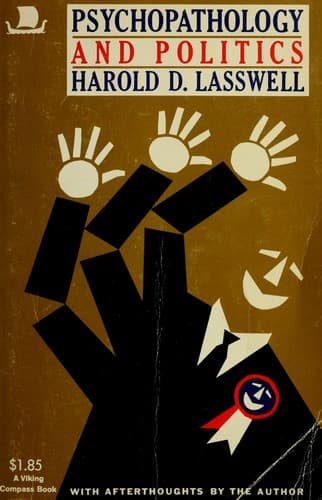
Psychopathology and politicsLasswell, Harold D. (Harold Dwight)
Science
Psychopathology and politics
Lasswell, Harold D. (Harold Dwight)
Personality and politics; Political science; Psychoanalysis; Psychology, Pathological
The actual content of his delusional productions gives a clue to his
mental conflict. He had ideas of reference, imagining that people on
the street were looking at him mysteriously. He claimed that he was a
party to the Teapot Dome scandal and that there was a dictaphone in
the house. On the way to be examined at a sanitarium he claimed that
he was being trailed by policemen. Upon admission he claimed that the
orderlies were policemen, that he was being electrocuted, that his bed
was wired to record all his movements, and that filthy songs were sung
to him (with homosexual content). Discharged from the sanitarium, he
was taken to a family reunion. He claimed to be treated as a negro,
and declined to eat with family or sleep in the house. B claimed that
a forest fire was caused by him and that books in the library were
re-written on his account. On a motor trip he claimed that insulting
remarks were made to him at every gas station. He turned against his
wife (he had been sexually inactive in marriage), and finally called
her a snake who ought to be killed, and proceeded to try it.
During the course of his psychosis it emerged that he recalls a sexual
seduction by his older brother, and that he had been bothered by
this fancy all his life. There was material to show that his father
was likewise implicated in his homosexual fantasies, and that he had
“eroticized” the injustices of his father and the physical attacks of
his brother.[35]
The history of B belongs to a borderline group between agitators
and administrators. His administrative ability is manifest in the
managing editorships which he held, and in the special service which
he organized and for a time conducted. His rôle as an agitator (in
writing) began when he was twenty, and continued for more than another
score of years. When this record is taken in juxtaposition to that
of A, it shows how differences in displacement affect the growth
of the personality. B was never able to displace his hatred and
affections to remote, impersonal objects with the degree of success
which characterized A. The campaigns of B against injustice were more
concrete, more limited, and more personal than the agitations of A. It
will be remembered that B’s first crusade was against black-and-tan
houses of prostitution, and this was in the nature of a revenge and
a penance for his early experience with the colored woman. B was
raised in a relatively inarticulate environment. His father made no
public appearances, no member of the family achieved more than a
rudimentary education, and no conversation was possible beyond the
visible environment. Since B went to work at sixteen, he saw the
world more from a concrete point of view while A was peering at the
universe through the theoretical lenses of the schools. His history
shows prolonged preoccupation with his own specific grievances against
the original objects--against the father, brother, and aunt. This was
Public-domain text, read in full here on John Shaqi.
Reviews
Reviews
No reviews yet
Be the first to share your thoughts on this work.
Elsewhere in the archive
Join the Discussion
Join the discussion
Sign in to leave a comment or review.
Sign InorCreate an account