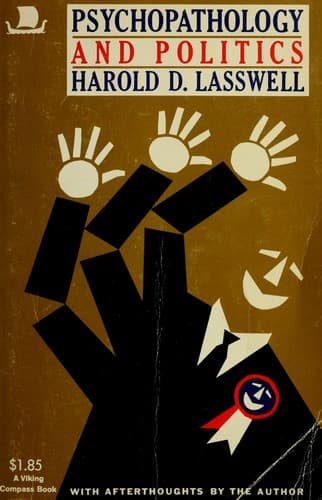
Psychopathology and politicsLasswell, Harold D. (Harold Dwight)
Science
Psychopathology and politics
Lasswell, Harold D. (Harold Dwight)
Personality and politics; Political science; Psychoanalysis; Psychology, Pathological
D has an impressive, deliberate manner. There are no marks of the
maniac about him to fit into the popular idea of a “crazy man.”
In conversation with strangers he puts his own case, and the
case of others, with seeming moderation, emphasizing the obvious
difficulties in the way of collecting conclusive evidence, and showing
scrupulousness about affidavits and other documentary material. He has
succeeded in establishing connections with prominent people in many
walks of life, and is devoting himself to the cause of the underdog,
with special reference to those unfortunates who are thrown into insane
asylums and kept there by enemies who league themselves with doctors
and superintendents.
He is associated with groups of people who band together in little
agitational organizations with such unexceptionable names as
Vigilantes of the Constitution, Foundation for Legal and Human Rights,
American Equity Association. Their indictment of modern jurisprudence
is pithily formulated in the slogan, “One Law for the Rich--Another Law
for the Poor.” The object of one of these associations is:
To secure to all persons the rights, privileges, and immunities
which are theirs under the Constitution and laws of the United
States, and to which they are justly entitled as members of the
human family.... Those aided are: worthy cases unable to hire legal
counsel; victims of corrupt practices; friendless and unfortunates
restrained in Institutions, who require assistance; ex-service men
who have not been able to have legitimate claims considered, etc.,
etc.
One of the cases which is often referred to in the papers published
by this group is that of William J. O’Brien. The headline of one
article reads as follows: “Poor Private Wm. J. O’Brien, Sane
Veteran of the Apache Indian Campaign, Railroaded to the Madhouse.
Denied Justice--Denied His Day in Court--No Trial--No Lunacy
Proceedings--Illegally Held 34 Years....” In the body of the article
this statement occurs: “Mr. O’Brien indulged in some disorderly
conduct in the office of the War Department. He was immediately
arrested, charged with assault which he did not commit, and brought
into the Supreme Court.” I examined the record of the O’Brien case and
found that “some disorderly conduct” consisted in visiting the War
Department, shooting two clerks, and trying to shoot some more before
his gun jammed.
Public-domain text, read in full here on John Shaqi.
Reviews
Reviews
No reviews yet
Be the first to share your thoughts on this work.
Elsewhere in the archive
Join the Discussion
Join the discussion
Sign in to leave a comment or review.
Sign InorCreate an account