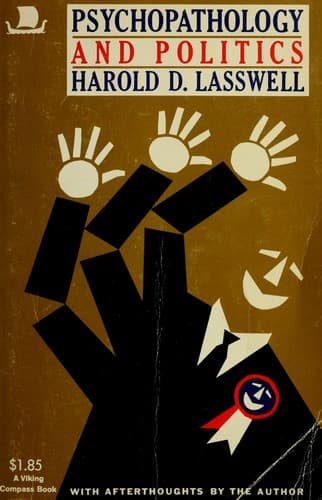
Psychopathology and politicsLasswell, Harold D. (Harold Dwight)
Science
Psychopathology and politics
Lasswell, Harold D. (Harold Dwight)
Personality and politics; Political science; Psychoanalysis; Psychology, Pathological
F’s anxiety to “do his bit” in the suspicion-ladened atmosphere which
surrounded America’s entry into the war led his suspicious nature to
overdo the matter. When some of his efforts were blocked by fellow
officers, he began to develop persecutory ideas. But he was soon able
to dispense with them by reinforcing his identification with the
interests of the nation and God, and displacing his suspicions upon
more generalized foes. When his secret-service work was blocked, he
was able to make a transition to agitation, where he balanced the
lost gratification of cherishing secret knowledge with the pleasure
of exhibiting it in public. The record does not contain enough early
childhood material to justify one in venturing to select the determiner
of his capacity to make such an adjustment. The history simply
furnishes a striking example of how a flight into agitation may perform
the function of keeping the personality in some sort of passable
relation to reality, when it has met a serious setback. It gives
another instance to the sum of those which show the difficulties which
may be created in society by those whose personality is influenced by
strong paranoidal trends.
The histories so far abstracted have had to do with male agitators
of various kinds. Miss G, when thirty-five years of age, came to the
physician complaining that she was constantly bothered by blushing,
stage fright, uncertainty, palpitations of the heart, and weeping
spells. She is known to be forceful, ambitious, and aggressive. Her
contentiousness is notorious. She is active in the support of all
kinds of measures, particularly for the emancipation of women from the
domination of men. She rose to her present distinction from a very
humble position as a handworker, and she champions the radical cause.
An early reminiscence was recovered during analysis which had been
completely buried before. Sometime between the ages of five and
three she had been asked by a nurse to touch her nurse’s genitals,
and threatened with dire things if she told. When she was in bed
with her mother, she had to fight against a powerful compulsion to
touch her mother’s genitalia. This early assumption of the male rôle
was strengthened by her father-identification. In the analysis she
reported that she and her father possessed many common traits, such as
stubbornness. As sometimes happens with children showing traits of the
opposite sex, their brothers or sisters reveal cross-traits. Thus her
younger brother cooked and sewed. Her father took her side in family
altercations with the mother (the father was an artist). The mother was
religious, and on the death of her mother the patient was religious
for six months from a sense of possible guilt for having precipitated
her death. Everybody said that she ought to have been a boy since
she showed so much physical dash and hardihood. Between six and ten
she often stole money from her parents, and was caught reading other
people’s letters.
Public-domain text, read in full here on John Shaqi.
Reviews
Reviews
No reviews yet
Be the first to share your thoughts on this work.
Elsewhere in the archive
Join the Discussion
Join the discussion
Sign in to leave a comment or review.
Sign InorCreate an account