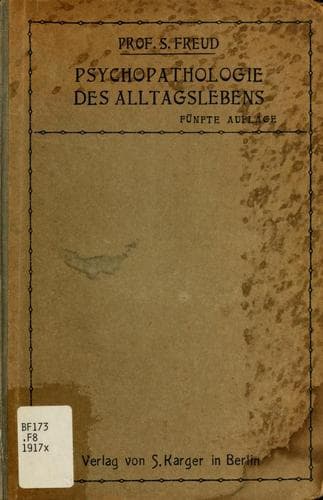
Association of ideas; Memory; Paragrammatism; Psychoanalysis; Psychology, Pathological; Repression (Psychology)
In the journal _Cœnobium_, Maeder relates about a hospital physician
who, on account of an important matter, desired to get to the city
that evening, although he was on duty and had no right to leave the
hospital. On his return he noticed to his surprise that there was a
light in his room. On leaving the room he had forgotten to put it out,
something that had never happened before. But he soon grasped the
motive of this forgetting. The hospital superintendent who lived in
the same house must have concluded from the light in the room that he
was at home. A man overburdened with worries and subject to occasional
depressions assured me that he regularly forgot to wind his watch
on those evenings when life seemed too hard and unfriendly. In this
omission to wind his watch he symbolically expressed that it was a
matter of indifference to him whether he lived to see the next day.
Another man who was personally unknown to me wrote: “Having been struck
by a terrible misfortune, life appeared so harsh and unsympathetic,
that I imagined that I had not sufficient strength to live to see
the next day. I then noticed that almost every day I forgot to wind
my watch, something that I never omitted before. I had been in the
habit of doing it regularly before retiring in an almost mechanical
and unconscious manner. It was only very seldom that I thought of
it, and that happened when I had something important for the next
day which held my interest. ‘Should this be considered a symptomatic
action? I really cannot explain it.’” Whoever will take the trouble,
like Jung (_The Psychology of Dementia Præcox_, translated by Peterson
and Brill), or Maeder (“Une voie nouvelle en Psychologie--Freud et
son ecole,” _Cœnobium_, Lugano, 1906), to pay attention to melodies
which one hums to himself aimlessly and unconsciously, will regularly
discover the relation of the melody’s text to a theme which occupies
the person at that time.]
[Footnote 60: “Das Verlieren als Symptom-handlung,” _Zentralb. f.
Psychoanalyse_, i. 10-11.]
[Footnote 61: Translated by A. A. Brill. The Macmillan Company, New
York; George Allen Company, London.]
[Footnote 62: This is not a perfect error. According to the orphic
version of the myth the emasculation was performed by Zeus on his
father Kronos.]
[Footnote 63: _Loc. cit._, p. 191.]
[Footnote 64: Nouvelles contributions, etc., _Arch. de Psych._, vi.
1908.]
[Footnote 65: _Loc. cit._, p. 42.]
[Footnote 66: _Zentralb. f. Psychoanalyse_, ii. 9.]
[Footnote 67: _Zentralb. f. Psychoanalyse_, ii. 5.]
[Footnote 68: This continued action in the unconscious manifested
itself once in the form of a dream which followed the faulty action,
another time in the repetition of the same or in the omission of a
correction.]
[Footnote 69: Alfred Adler, “Drei Psychoanalysen von Zahlen einfällen
und obsedierenden Zahlen,” _Psych. Neur. Wochenschr._, No. 28, 1905.]
Public-domain text, read in full here on John Shaqi.
Reviews
Reviews
No reviews yet
Be the first to share your thoughts on this work.
Elsewhere in the archive
Join the Discussion
Join the discussion
Sign in to leave a comment or review.
Sign InorCreate an account