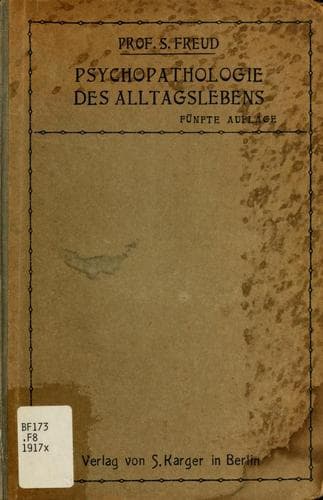
Association of ideas; Memory; Paragrammatism; Psychoanalysis; Psychology, Pathological; Repression (Psychology)
(_f_) That accidental actions are really intentional will find no
greater credence in any other sphere than in sexual activity, where the
border between the intention and accident hardly seems discernible.
That an apparently clumsy movement may be utilized in a most refined
way for sexual purposes I can verify by a nice example from my own
experience. In a friend’s house I met a young girl visitor who excited
in me a feeling of fondness which I had long believed extinct, thus
putting me in a jovial, loquacious, and complaisant mood. At that time
I endeavoured to find out how this came about, as a year before this
same girl made no impression on me.
As the girl’s uncle, a very old man, entered the room, we both jumped
to our feet to bring him a chair which stood in the corner. She was
more agile than I and also nearer the object, so that she was the
first to take possession of the chair. She carried it with its back to
her, holding both hands on the edge of the seat. As I got there later
and did not give up the claim to carrying the chair, I suddenly stood
directly back of her, and with both my arms was embracing her from
behind, and for a moment my hands touched her lap. I naturally solved
the situation as quickly as it came about. Nor did it occur to anybody
how dexterously I had taken advantage of this awkward movement.
Occasionally I have had to admit to myself that the annoying, awkward
stepping aside on the street, whereby for some seconds one steps
here and there, yet always in the same direction as the other person,
until finally both stop facing each other, that this “barring one’s
way” repeats an ill-mannered, provoking conduct of earlier times
and conceals erotic purposes under the mask of awkwardness. From my
psychoanalysis of neurotics I know that the so-called naïveté of young
people and children is frequently only such a mask, employed in order
that the subject may say or do the indecent without restraint.
W. Stekel has reported similar observations in regard to himself: “I
entered a house and offered my right hand to the hostess. In a most
remarkable way I thereby loosened the bow which held together her loose
morning-gown. I was conscious of no dishonourable intent, still I
executed this awkward movement with the agility of a juggler.”
(_g_) The effects which result from mistakes of normal persons are, as
a rule, of a most harmless nature. Just for this reason it would be
particularly interesting to find out whether mistakes of considerable
importance, which could be followed by serious results, as, for
example, those of physicians or druggists, fall within the range of our
point of view.
Public-domain text, read in full here on John Shaqi.
Reviews
Reviews
No reviews yet
Be the first to share your thoughts on this work.
Elsewhere in the archive
Join the Discussion
Join the discussion
Sign in to leave a comment or review.
Sign InorCreate an account