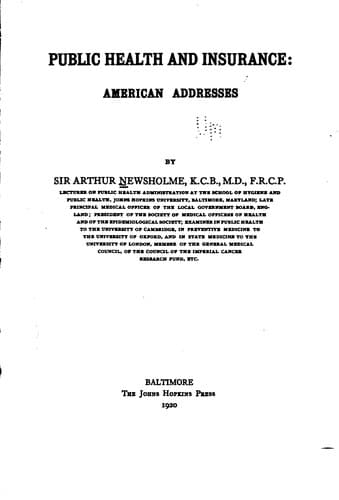
Public health and insurance: American addressesNewsholme, Arthur, Sir
History
Public health and insurance: American addresses
Newsholme, Arthur, Sir
Health insurance -- Great Britain; Public health; Public health -- Great Britain
Intelligent human society, permeated more than we realise by the
essentials of Christianity, has already gone far in securing
remedies, notwithstanding the too frequent other-worldliness or
lack of vision of those who should have been foremost in rebuilding
Jerusalem in this green and pleasant land. Industrialism no sooner
huddled together labourers and their families in the courts and
alleys of insanitary towns and overworked them for scanty wages, than
the voices of such philanthropists as Percival, Oastler, Shaftesbury,
Owen, and of many others were heard in favour of interference with
that freedom (!) of contract between workers and employers, which the
professors of the dismal science regarded as a fundamental principle
in political economy. And so gradually, too slowly, regulated
industry, improved sanitation, better housing, the isolation and
hospitalisation of infectious cases, the readier access than in rural
districts of all sick to skilled treatment, higher wages, better
food began to counteract the evils of industrialism and urbanization.
Communal action was taken in the regulation of industry, in the
promotion of sanitation, in providing elementary education; and the
result is seen in the remarkable fact that, notwithstanding its
enormous handicap, urban life has become almost as safe as rural
life, so far as life itself is concerned, though not in standard of
health.
The first lesson, then, which has already been partially learnt, is
that _no member of a community can live to himself_. We now believe
in the solidarity of society; that the sores of one section of it
means peril for all. And we are gradually learning to appreciate
that this is true not only in respect of the acute infectious
diseases, and of chronic infectious diseases, such as tuberculosis
and syphilis, but of every disease and of every other factor in life
which causes individual inefficiency, and which consequently inflicts
additional burdens on the competent section of the community. I do
not wish to underestimate the basic self-centredness, if not actual
selfishness, which, to a varying extent, is part of the nature of all
of us; but in industrial, as in other social problems, whatever may
be the intermediate turmoil and misunderstandings and disturbance
which appear to loom so threateningly, it is plain that the mere
cash nexus of relationship is becoming more and more entangled in
a moral nexus; and that a prophet’s vision is scarcely needed to
forecast a future of consolidation and conformity of efforts of
employers and employed such as has never yet been generally realised.
In such a consolidation the idea of servitude will disappear, and
mutual service will take its place. This will happen by the growth
of an idealistic standpoint; even more, perhaps through motives of
community self-defence.
Public-domain text, read in full here on John Shaqi.
Reviews
Reviews
No reviews yet
Be the first to share your thoughts on this work.
Elsewhere in the archive
Join the Discussion
Join the discussion
Sign in to leave a comment or review.
Sign InorCreate an account