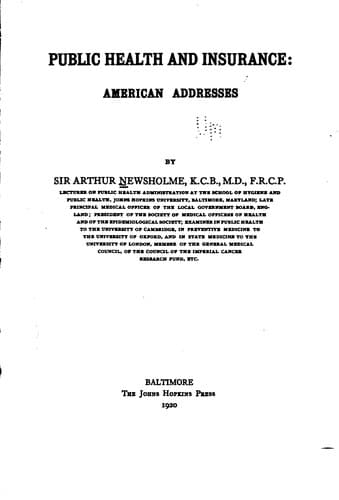
Public health and insurance: American addressesNewsholme, Arthur, Sir
History
Public health and insurance: American addresses
Newsholme, Arthur, Sir
Health insurance -- Great Britain; Public health; Public health -- Great Britain
The dispensary should be the active working centre from which
home visitation is undertaken; and this is especially important
in “following up” work. Following up is needed for persons who
have been examined once, concerning whom there is doubt as to
their freedom from disease and who fail to present themselves for
later examination. It is needed also for patients who have been
under treatment and neglect to continue it; and for patients who
after having been treated have been discharged and fail to report
themselves at intervals as directed. It is important to have
efficient arrangements for ascertaining these leakages and for making
the necessary inquiries. The method of securing this will vary
according to local circumstances; but the following example given by
Dr. Chapman of an official method may be placed on record:
When a patient is instructed to attend again at the dispensary his
name is noted in a diary under the date upon which he is asked
to attend. In some instances a definite time is fixed for the
appointment so as to save the patient’s time. The names of all
patients who attended the dispensary upon the day appointed are
ticked off as they are seen, and at the end of the day the names of
patients who have failed to attend remain on the list. Letters are
then sent reminding these patients of their engagement and making
another appointment. If they still fail to attend they are visited
by the dispensary nurse or the health visitor. Failure to attend
may be due to relapse, and, when this is likely, an early visit of
inquiry by the nurse is advantageous.
Examination of a register kept for facilitating work of this kind
showed that the majority of the patients followed up attended
subsequently, and that in the cases of the remainder non-attendance
as a rule was satisfactorily explained.
In areas having, as yet, no adequate system of following up, an
appreciable percentage of patients usually cease to attend during the
course of treatment at a dispensary, and many are lost sight of after
discharge from a sanatorium. The value of the work of a dispensary
and of after-care work is materially impaired in the absence of
a system of “following up.” As schemes develop, more stress will
doubtless be generally laid upon this branch of the dispensary
function.
_“Sanatorium Benefit.”_
Under the National Insurance Act the annual sum of 1s 3d (30 cents)
was set apart for each insured person; as the result of subsequent
bargaining with medical practitioners 6d of this was devoted to
the domiciliary treatment of tuberculosis patients (payable on the
number of panel patients on each doctor’s list, not on the number
of his tuberculous patients), the remainder being payable to local
authorities who undertook the provision of institutions for the
treatment of tuberculous insured patients.
Thus the “Sanatorium Benefit” comprises
Public-domain text, read in full here on John Shaqi.
Reviews
Reviews
No reviews yet
Be the first to share your thoughts on this work.
Elsewhere in the archive
Join the Discussion
Join the discussion
Sign in to leave a comment or review.
Sign InorCreate an account