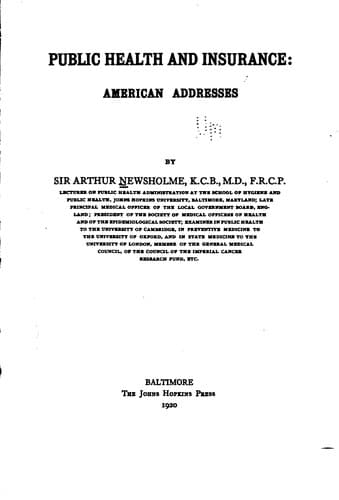
Public health and insurance: American addressesNewsholme, Arthur, Sir
History
Public health and insurance: American addresses
Newsholme, Arthur, Sir
Health insurance -- Great Britain; Public health; Public health -- Great Britain
1. Patients who may be expected to recover considerable ability to
work, as a result of protracted treatment.
2. Patients admitted for a short term for educational treatment.
3. Patients with advanced disease, many of whom improve greatly
under institutional treatment.
Group _C_—Advanced cases requiring continuous medical care and
nursing.
Group _D_—Cases requiring Special Observation.
1. Patients admitted for the purpose of diagnosis.
2. Patients needing to be watched, before the best form of continued
treatment can be determined.
Emergency cases, e.g., patients with haemoptysis, and patients
requiring surgical treatment may come within any of the above groups.
Of the 12,441 beds probably 5,000 are in the hands of voluntary
organizations, and are intended for patients in group _A_, though
for the reasons set out on pages 208 and 223 they contain a large
proportion of patients in the other groups. It appears not unlikely,
however, that the total accommodation, official and voluntary,
for patients in group A has reached one bed per 5,000 population,
the accommodation recommended by the Departmental Committee on
Tuberculosis as immediately advisable. This accommodation is unevenly
distributed and much of it is being utilised for patients coming
within groups _B_, _C_, and _D_. All the evidence available shows
a great need for additional beds for patients coming within the
last-named groups. The Departmental Committee recommended that the
total needs of the community might be assumed to amount to one bed
to 2,500 population for all stages of pulmonary tuberculosis, in
addition to poor-law accommodation. This means a provision of some
14,000 beds in addition to the 9,000 poor-law beds, or a total
provision of about one bed to 1,500 population.
If we include cases of non-pulmonary tuberculosis it may be safely
assumed that each community should aim at having available for the
treatment of tuberculosis at least one bed per 1,000 inhabitants.
Fewer beds may suffice for sparsely populated communities, and more
will be needed in some towns.
In England various existing institutions have been utilised in the
treatment of tuberculosis.
1. Emphasis has already been laid on the large number of beds in
_workhouse infirmaries under the Poor-Law Authorities_. Of the
historical, as well as of the present value of this accommodation
for advanced cases of tuberculosis in the poorest section of the
population—which is most seriously exposed domestically to massive
infection,—there can be no doubt.
But there has been prejudice against the use of this accommodation
for insured persons, and such use is legally precluded; and since
the passing of the National Insurance Act additional provision has
been made by Public Health Authorities, and ere long the whole of
the present poor-law accommodation should come under public health
authorities.
Public-domain text, read in full here on John Shaqi.
Reviews
Reviews
No reviews yet
Be the first to share your thoughts on this work.
Elsewhere in the archive
Join the Discussion
Join the discussion
Sign in to leave a comment or review.
Sign InorCreate an account