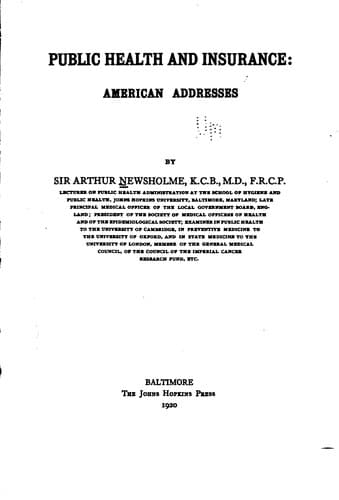
Public health and insurance: American addressesNewsholme, Arthur, Sir
History
Public health and insurance: American addresses
Newsholme, Arthur, Sir
Health insurance -- Great Britain; Public health; Public health -- Great Britain
The conditions of local administration of the Sanatorium Benefit
under the National Insurance Act have led to a very high proportion
of consumptives being treated in sanatoria with a view to cure,
who might advantageously have received educational treatment for a
few weeks and then have been treated at home or at a tuberculosis
dispensary. Furthermore, a large number of patients with advanced
disease have been sent to sanatoria for whom treatment in a hospital
was more appropriate.
_Educational Work of Sanatoria_
Apart from the question of cure, which with belated treatment can
only be expected in a minority of cases, the sanatorium serves an
important purpose, not only in restoring patients to a considerable
degree of health and working capacity for a longer or shorter
time, but also in educating the patients how to live and conduct
themselves. A stay in a sanatorium for a short period—a month or
six weeks—under doctors and nurses who realise the value of this
work—would there were more of these!—secures the training of the
patient on lines beneficial to his future health and enables him to
obviate all danger for others.
In such a short stay in a sanatorium what may be called tuberculosis
discipline can be and is acquired when the sanatorium is
satisfactorily administered; and the patient thus disciplined is in
a much more favorable position for securing his own welfare and that
of others than the undisciplined patient, just as the soldier who has
had routine drill under a competent instructor is more efficient
than the untrained recruit.
The preceding remarks as to the treatment of tuberculosis in
sanatoria illustrate certain well-known features in the natural
history of this disease. In the majority of instances of disease
recognised under present conditions we are dealing with a slowly
progressing disease. This sometimes become spontaneously arrested;
occasionally it may be arrested or its course delayed under
medical treatment at home associated with manageable changes in
domestic and industrial life. In still further instances it may
be arrested by treatment in a sanatorium; while for other cases
sanatorium treatment, however prolonged, is followed by only
temporary improvement, and the chief benefit thus received is that
of training as to mode of life, which might have been secured by a
much less protracted stay in the institution, followed by measures
supplementing sanatorium treatment. We have further to recognise
the fact that, under present conditions of social life and medical
practice, many tuberculous patients will slowly, by intermittent
stages, but none the less surely, die from tuberculosis in the course
of one, three or five years. Regard must be paid to this fact if our
total measures for the control of tuberculosis are to be successful.
_Hospital Treatment_
Public-domain text, read in full here on John Shaqi.
Reviews
Reviews
No reviews yet
Be the first to share your thoughts on this work.
Elsewhere in the archive
Join the Discussion
Join the discussion
Sign in to leave a comment or review.
Sign InorCreate an account