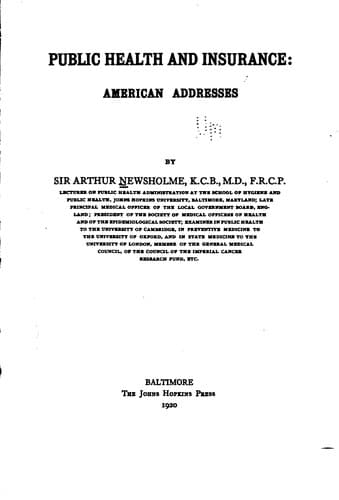
Public health and insurance: American addressesNewsholme, Arthur, Sir
History
Public health and insurance: American addresses
Newsholme, Arthur, Sir
Health insurance -- Great Britain; Public health; Public health -- Great Britain
This may imply extensions of work involving serious economic
considerations; but apart from such possibilities and apart from
questions of housing, and of provision of additional domestic
facilities for assisting the overworked mother, there is ample
evidence that medical and hygienic measures by themselves can do much
to relieve the excessive strain on the mother which childbearing
under present conditions often involves.
_The Course of Mortality from Childbearing_
The general course of mortality from childbearing (including deaths
ascribable to pregnancy) in England and Wales is shown by the
following table:
_Average Annual Death-rates per 100,000 births from_
Puerperal Other Diseases
Septic of Pregnancy
Diseases and Childbirth
5 years, 1902-06 185 228
5 years, 1907-11 152 215
3 years, 1912-14 148 233
2 years, 1915-16 151 239
It will be noted that although there has been a marked decline of
deaths from puerperal sepsis, the death-rate from other complications
of childbearing has not declined. The decline in puerperal sepsis
is general throughout the country, and evidences the greater care
in midwifery both on the part of doctors and of midwives. The
administration of the Midwives Act, 1902, has doubtless done much
to secure this. The death-rate from conditions other than puerperal
fever continues to differ greatly throughout the country. It is
highest in Welsh counties, Westmoreland, Lancashire and Cheshire
coming next in order of unfavourable portion; in many industrial,
including textile, towns it is also excessive. The general conclusion
reached by the writer in an elaborate official report on the subject
is that “the quality and availability of skilled assistance before,
during, and after childbirth are probably the most important factors
in determining the remarkable and serious differences in respect of
mortality from childbearing shown in the report.”—“The differences
are caused in the main by differences in availability of skilled
assistance when needed in pregnancy, and at and after childbirth.”
_The Midwives Act, 1902_
This Act forbade any woman after April 1, 1906, who was not certified
under the Act, from using the title of midwife or any similar
description of herself. It forbade after April 1, 1910, any such
woman from “habitually and for gain attending women in childbirth,
except under the direction of a qualified medical practitioner”; and
it forbade any certified midwife to use an uncertified person as her
substitute. The Act defined the limits of function of the midwife
by stating that the Act did not confer upon her any title to give
certificates of death or of still-birth, or to take charge of any
abnormality or disease in connection with parturition.
Public-domain text, read in full here on John Shaqi.
Reviews
Reviews
No reviews yet
Be the first to share your thoughts on this work.
Elsewhere in the archive
Join the Discussion
Join the discussion
Sign in to leave a comment or review.
Sign InorCreate an account