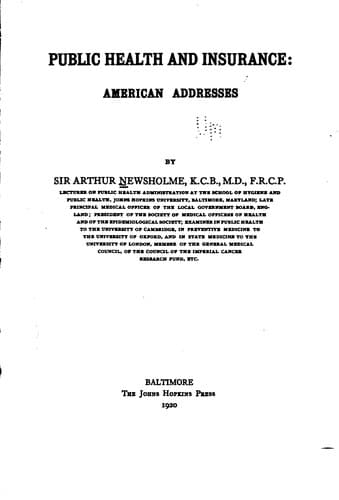
Public health and insurance: American addressesNewsholme, Arthur, Sir
History
Public health and insurance: American addresses
Newsholme, Arthur, Sir
Health insurance -- Great Britain; Public health; Public health -- Great Britain
The increase during the war period has been very great; and this can
be attributed to the desire to do everything practicable for mothers
and children, especially those belonging to soldiers and sailors
who were risking their lives for the country; and to the increased
realisation of the importance of preserving and improving our chief
national asset which consists in a healthy population. During this
period there was a great increase in the industrial employment of
women, including married women, in factories including munition and
other works. This increase it is believed amounted to a million and a
half workers.
Notwithstanding the many adverse influences, to which must be added
great overcrowding in many industrial areas, especially those in
which new industries were hurriedly started, and the increasing cost
of food and especially of milk with a scarcity of supply, it has been
seen that infant mortality remained low and on the whole declined
during the whole period of the war.
To what circumstances can this be ascribed?
It is unnecessary to assume that this result was entirely due to the
active measures favorable to maternity and child welfare which were
taken as an unexampled scale, though these measures can claim an
important share in the result.
A number of contributory factors were at work:
1. In none of the years in question did the summer weather favor an
excess of diarrhœal mortality. With this factor, however, eliminated
the infant mortality each year was lower than in previous years.
2. Although so many husbands were away from home, in a large
proportion of cases the wife, in virtue of her separation allowance,
was financially in a more favorable position than when she was
dependent on her husband’s wages or such portion of it as he allowed
her for the support of the household.
3. In addition, every soldier became an insured person, and his wife
was therefore entitled to the Maternity Benefit of 30 shillings on
the birth of a child, and an additional 30 shillings if she was
herself an employed person.
4. There can be no reasonable doubt that the restrictions on the
consumption of alcoholic drinks and the limitation of hours for
opening public houses were a factor in improving domestic welfare.
But attaching full value to these and other similar factors which
undoubtedly were at work, chief place must, I think, be given to
the awakening of the public conscience on the subject, and to the
concentration on the mother and her child which had been urged in
season and which now became a fact. An indication of the public
mind is given by the advice issued by the Local Government Board in
August, 1918, which is quoted on page 248.
FOOTNOTES:
[18] Extracted from addresses given at Conferences held by the
Children’s Bureau of the Department of Labor, Washington.
INDEX
Abbott, J., 2
Abbott, S. W., 2
Alcoholic drinks, 123, 149, 187
Anaesthetics, 77
Ante-natal work, 261
Public-domain text, read in full here on John Shaqi.
Reviews
Reviews
No reviews yet
Be the first to share your thoughts on this work.
Elsewhere in the archive
Join the Discussion
Join the discussion
Sign in to leave a comment or review.
Sign InorCreate an account