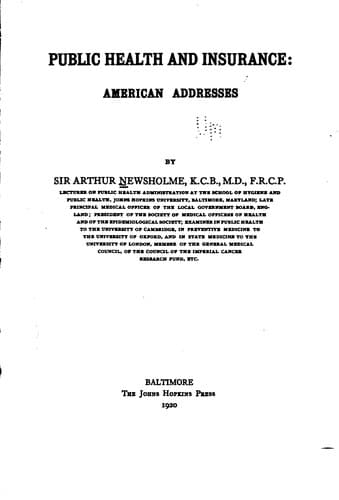
Public health and insurance: American addressesNewsholme, Arthur, Sir
History
Public health and insurance: American addresses
Newsholme, Arthur, Sir
Health insurance -- Great Britain; Public health; Public health -- Great Britain
Nothing is more conspicuous in recent years than the growth of
sensibility on the subject of economic evils, especially as to the
conditions of industry. Economic efficiency, as a sole object,
appeared to preclude regard to morality of method, and the result
has been poverty for the masses of mankind. If this is to cease,
satisfactory minimum standards of comfort and welfare for the entire
population must be accepted, which will form a first charge on
industry. This can only be hoped for when there is complete practical
acceptance of the fact that “we are members one of another,” and
servitude is completely replaced by the ideal of mutual service.
(_c_) The Malthusian hypothesis ignores the great though paradoxical
truth, that although under circumstances permitting malnutrition and
defective training, large families spell poverty, especially when
population is not distributed where it is needed, the real wealth of
the world after all depends on man himself. Nature gives him little
that he can use in the form in which he finds it. It is by him and by
him alone that “wealth” is created by converting useless into useful
matter.
It appears to me clear that over-population need not excite
apprehension; that population in itself is the only means by which
national wealth can materialise; and that our chief aim in securing
national efficiency must be to train each unit of the population
adequately for work, and to prevent the terrible loss of efficiency
due to avoidable sickness.
And this brings me to the direct statement of the truism that health
progress can only be secured by preventing preventible illness.
Poverty and disease are allied in the closest relationship; and
while it is true that the removal of poverty would effect a great
improvement in national health, it is even truer that the prevention
of illness forms the most important means for the avoidance of
poverty.
In various reports it has recently been shown that in a number of
districts an inverse correlation exists between infant mortality and
the amount of the family income; the implication appearing to be that
increase of the lower income is the best and perhaps the only method
for obviating excessive loss of infantile life.
In such an argument poverty evidently is considered as an element,
instead of as a highly complex phenomenon needing to be further
analyzed into its constituent parts. In the instance quoted, the
fact that the correlation between poverty and high infant mortality
is not essential can be shown by examples of low infant mortality
in communities in which poverty is the rule; by examples of high
infant mortality in which wages are high; and by other examples of
communities in which high infant mortality has been lowered without
any change in economic conditions.
Public-domain text, read in full here on John Shaqi.
Reviews
Reviews
No reviews yet
Be the first to share your thoughts on this work.
Elsewhere in the archive
Join the Discussion
Join the discussion
Sign in to leave a comment or review.
Sign InorCreate an account