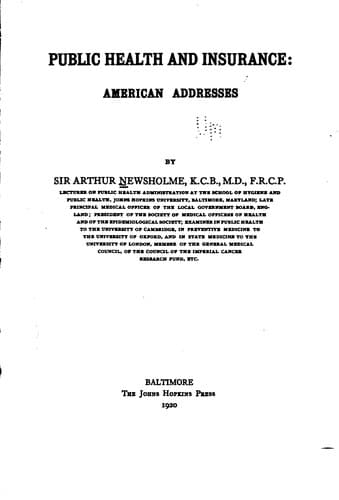
Public health and insurance: American addressesNewsholme, Arthur, Sir
History
Public health and insurance: American addresses
Newsholme, Arthur, Sir
Health insurance -- Great Britain; Public health; Public health -- Great Britain
are even more pernicious than lack of knowledge. No member of any
of our local authorities can fail to have been warned that typhoid
fever is still being spread in many communities by impure water, and
as the result of inadequate hospital isolation of cases. The means
of prevention of tuberculosis are well known; but how few local
authorities will face the problem of supplying adequate funds for
clinics, for examination of contacts, for hospitals for bed-ridden
cases, and for convalescent homes; and how few are willing to give
help to ensure that the consumptive patient has a separate bedroom?
In how few instances are the regulations against indiscriminate
expectoration enforced, and how seldom are physicians called to
account for not obeying the law as to prompt notification of cases of
tuberculosis? Will all the “drives” against tuberculosis effectually
remedy this condition of things? Would not public opinion amply
support _the one “drive” which, above all others, is necessary_: a
systematized effort on the part of all social workers to exact a
definite promise from every candidate for local or state office that
he will give earnest support to all well-considered anti-tuberculosis
measures, for the diminution of venereal diseases, for improving the
welfare of mothers and their children, for promoting school hygiene,
and for improving the housing of the poor. Democratic Government,
alas! hitherto, has meant government by active minorities. The great
danger of democracy is that the minority may and often does consist
largely of persons having a mercenary interest in the machinery of
local government. Why should not it become an active and preponderant
minority of health gospellers? This will involve the taking of
infinite trouble to overcome the multiform activities associated
with “political pull”; it will involve the watching of the record
of each elected person, merciless exposure of those who do not
whole-heartedly support reforms, and systematic effort to prevent
the reëlection of all whose record proves unsatisfactory. Are we
equal to this task? Is our national and local patriotism equal to
this heroic test, involving most prosaic work, the surveillance and
the “besting” of the politician? If not, our indirect attack on the
enemy by means of special educational drives can have relatively
little effect. Where the enemy is, there our fight should be; and
the chief enemies of health are local authorities possessing powers
to secure health for the community, who corruptly or parsimoniously
refrain from their duty. Nor can we avoid responsibility, or the
need for strenuous effort after efficiency by not taking part in
official or voluntary administrative work. We may have sufficiently
good reasons for this abstinence; and onlookers have their rôle in
life. If all were authors, where would be the readers? There are many
indifferent writers who would be appreciative readers, and the same
remark applies in local administration.
Public-domain text, read in full here on John Shaqi.
Reviews
Reviews
No reviews yet
Be the first to share your thoughts on this work.
Elsewhere in the archive
Join the Discussion
Join the discussion
Sign in to leave a comment or review.
Sign InorCreate an account