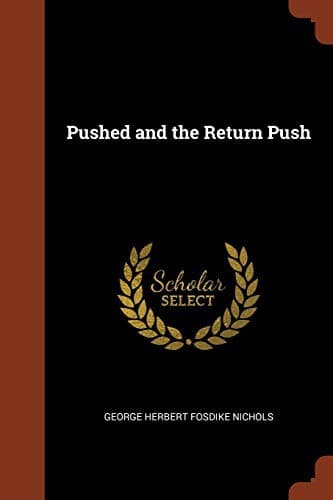
Pushed and the Return PushNichols, George Herbert Fosdike
History
Pushed and the Return Push
Nichols, George Herbert Fosdike
World War, 1914-1918 -- Personal narratives, English
I made out what did appear to be three grey tin-helmeted figures, but I
could see nothing of our infantry. The shelling went on, but time
pressed, and the colonel, packing up his glasses, led us eastwards
again, down to a light-railway junction, and through a quaint little
ravine lined with willow-trees. Many German dead lay here. One young
soldier, who had died with his head thrown back resting against a
green bank, his blue eyes open to the sky, wore a strangely perfect
expression of peace and rest. Up another ascending sunken road. The
Boche guns seemed to have switched, and half a dozen shells skimmed the
top of the road, causing us to wait. We looked again at the fight being
waged on the slopes behind the village. Our barrage had lifted, but we
saw no sign of advancing infantry.
The colonel turned to me suddenly and said, "I'm going to select
positions about a thousand yards south of where we are at this
moment--along the valley. Wilde will come with me. You go back and pick
up the horses, and meet us at Quennemont Farm. I expect we shall be
there almost as soon as you."
I followed the direct road to return to Bony. A few shells dropped on
either side of the road, which was obviously a hunting-ground for the
Boche gunners. At least a dozen British dead lay at intervals huddled
against the sides of the road. One of them looked to be an artillery
officer, judged by his field-boots and spurs. But the top part of him
was covered by a rain-proof coat, and I saw no cap.
Quennemont Farm was a farm only in name. There was no wall more than
three feet high left standing; the whole place was shapeless, stark,
blasted into nothingness. In the very centre of the mournful chaos lay
three disembowelled horses and an overturned Boche ammunition waggon.
The shells were still on the shelves. They were Yellow Cross, the
deadliest of the Boche mustard-gas shell.
I went on leave next morning, and got a motor-car lift from Peronne as
far as Amiens. Before reaching Villers-Bretonneux, of glorious, fearful
memories, we passed through Warfusee-Abancourt, a shell of its former
self, a brick heap, a monument of devastation. An aged man and a slim
white-faced girl were standing by the farm cart that had brought them
there, the first civilians I had seen since August. The place was
deserted save for them. In sad bereavement they looked at the cruel
desolation around them.
"My God," said my companion, interpreting my inmost thought, "what a
home-coming!"
XVIII. A LAST DAY AT THE O.P.
Public-domain text, read in full here on John Shaqi.
Reviews
Reviews
No reviews yet
Be the first to share your thoughts on this work.
Elsewhere in the archive
Join the Discussion
Join the discussion
Sign in to leave a comment or review.
Sign InorCreate an account