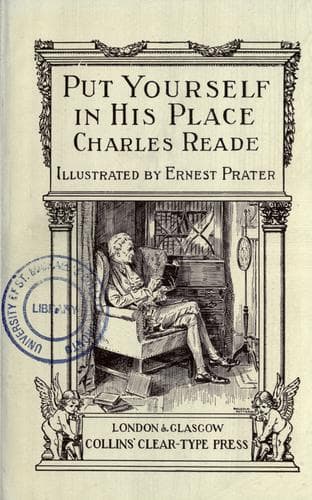
English fiction -- 19th century; Labor unions -- Fiction
If, in the middle of the pious harmony that had stirred her soul, some
blaring trumpet had played a polka, in another key, it could hardly have
jarred more upon her devotional frame, than did this earthly line, that
glared out between two gigantic yule candles, just lighted in honor of
Him, whose mother was in trade when he was born.
She turned from it with deep repugnance, and seated herself in silence
at the table.
Very early in the supper she made an excuse, and retired to her room:
and, as she went out, her last glance was at the mysterious picture.
She saw it again next morning at breakfast-time; but, it must be owned,
with different eyes. It was no longer contrasted with a religious
ceremony, and with the sentiments of gratitude and humility proper to
that great occasion, when we commemorate His birth, whose mother had
gone into trade. The world, and society, whose child she was, seemed now
to speak with authority from the canvas, and to warn her how vain
and hopeless were certain regrets, which lay secretly, I might say
clandestinely, at her heart.
She revered her godfather, and it was no small nor irrelevant discovery
to find that he had actually turned a picture in disgrace to the wall,
because its owner had descended to the level, or probably not quite to
the level, of Henry Little.
Jael Dence came up from the farm on Christmas afternoon, and almost the
first word Grace spoke was to ask her if she knew whose picture that was
in the dining-room. This vague description was enough for Jael. She said
she could not tell for certain, but she had once heard her father say
it was the Squire's own sister; but, when she had pressed him on the
subject, the old man had rebuked her--told her not to meddle too much
with other folks' business. “And, to be sure, Squire has his reasons, no
doubt,” said Jael, rather dryly.
“The reason that is written on the back?”
“Ay: and a very poor reason too, to my mind.”
“You are not the best judge of that--excuse me for saying so. Oh dear, I
wish I could see it.”
“Don't think of such a thing, miss. You can't, however, for it's
padlocked down that way you could never loose it without being found
out. No longer agone than last Yule-time 'twas only turned, and not
fastened. But they say in the kitchen, that one day last month Squire
had them all up, and said the picture had been tampered with while he
was at Hillsboro'; and he scolded, and had it strapped and padlocked
down as 'tis.”
The reader can imagine the effect of these fresh revelations. And a
lover was at hand, of good birth, good manners, and approved by her
godfather. That lover saw her inclining toward him, and omitted nothing
to compliment and please her. To be sure, that was no uphill work, for
he loved her better than he had ever loved a woman in his life, which
was a good deal to say, in his case.
Public-domain text, read in full here on John Shaqi.
Reviews
Reviews
No reviews yet
Be the first to share your thoughts on this work.
Elsewhere in the archive
Join the Discussion
Join the discussion
Sign in to leave a comment or review.
Sign InorCreate an account