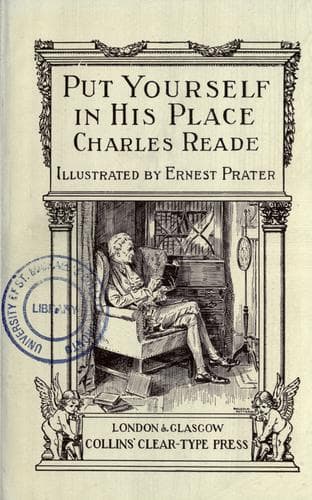
English fiction -- 19th century; Labor unions -- Fiction
“You know better than that, Ned. You are a freeman; but he won't be a
freeman's son by our law, thou knowst. But there's plenty of outside
trades in Hillsbro'. We'll bind him to one of those, and keep an eye on
him, for thy sake.”
“Well, I must take what I can get.”
“And little enough too,” said Eliza Watney. “Now do you know that they
have set upon Mr. Little and beaten him within an inch of his life? Oh,
Ned, you can't approve that, and him our best friend.”
“Who says I approve it, thou fool?”
“Then tell the gentleman who the villain was; for I believe you know.”
“I'll tell 'em summut about it.”
Grotait turned pale; but still kept his glittering eye fixed on the sick
man.
“The job was offered to me; but I wouldn't be in it. I know that much.
Says I, 'He has had his squeak.'”
“Who offered you the job?” asked Mr. Holdfast. And at this moment
Ransome came in.
“What, another black coat!” said Simmons. “----, if you are not like so
many crows over a dead horse.” He then began to wander, and Holdfast's
question remained unanswered.
This aberration continued so long, and accompanied with such
interruptions of the breathing, that both Holdfast and Ransome despaired
of ever hearing another rational word from the man's lips.
They lingered on, however, and still Grotait sat at the foot of the bed,
with his glittering eye fixed on the dying man.
Presently Simmons became silent, and reflected.
“Who offered me the job to do Little?” said he, in a clear rational
voice.
“Yes,” said Mr. Holdfast. “And who paid you to blow up the forge?”
Simmons made no reply. His fast fleeting powers appeared unable now to
hold an idea for above a second or two.
Yet, after another short interval, he seemed to go back a second time to
the subject as intelligibly as ever.
“Master Editor!” said he, with a sort of start.
“Yes.” And Holdfast stepped close to his bedside.
“Can you keep a secret?”
Grotait started up.
“Yes!” said Holdfast, eagerly.
“THEN SO CAN I.”
These were the last words of Ned Simmons. He died, false to himself, but
true to his fellows, and faithful to a terrible confederacy, which, in
England and the nineteenth century, was Venice and the middle ages over
again.
CHAPTER XIX.
Mr. Coventry, relieved of a great and immediate anxiety, could now turn
his whole attention to Grace Carden; and she puzzled him. He expected to
see her come down beaming with satisfaction at the great event of last
night. Instead of that she appeared late, with cheeks rather pale, and
signs of trouble under her fair eyes.
As the day wore on, she showed positive distress of mind, irritable and
dejected by turns, and quite unable to settle to anything.
Mr. Coventry, with all his skill, was quite at fault. He could
understand her being in anxiety for news about Little; but why not
relieve her anxiety by sending a servant to inquire? Above all, why this
irritation? this positive suffering?
Public-domain text, read in full here on John Shaqi.
Reviews
Reviews
No reviews yet
Be the first to share your thoughts on this work.
Elsewhere in the archive
Join the Discussion
Join the discussion
Sign in to leave a comment or review.
Sign InorCreate an account