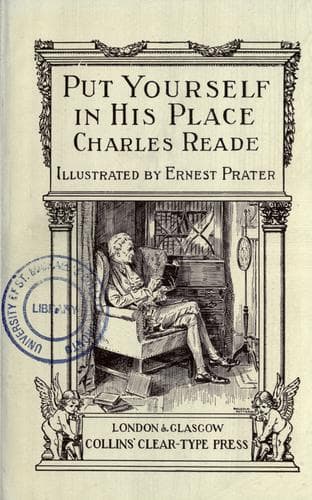
English fiction -- 19th century; Labor unions -- Fiction
“Because I'm no match for Miss Carden. But I hope to be, some day.”
“And she is to wait for you till then?”
“She says she will.”
“Well, Mr. Little, this is a delicate matter; but you are a
straightforward man, I see, and it is the best way. Now I must do my
duty as a parent, and I am afraid I shall not be able to do that without
mortifying you a little; but believe me, it is not from any dislike or
disrespect to you, but only because it IS my duty.”
“I am much obliged to you, sir; and I'll bear more from you than I would
from any other man. You are her father, and I hope you'll be mine one
day.”
“Well, then, Mr. Little, I always thought my daughter would marry a
gentleman in this neighborhood, who has paid her great attention for
years, and is a very suitable match for her. You are the cause of
that match being broken off, and I am disappointed. But although I am
disappointed, I will not be harsh nor unreasonable to you. All I say is
this: my daughter shall never marry any man, nor engage herself to any
man, who cannot make a proper settlement on her. Can YOU make a proper
settlement on her?”
“Not at present,” said Little, with a sigh.
“Then I put it to you, as a man, is it fair of you to pay her open
attentions, and compromise her? You must not think me very mercenary; I
am not the man to give my daughter to the highest bidder. But there is a
medium.”
“I understand you, sir, so far. But what am I to do? Am I to leave off
loving, and hoping, and working, and inventing? You might as well tell
me to leave off living.”
“No, my poor boy; I don't say that, neither. If it is really for her you
work, and invent, and struggle with fortune so nobly as I know you do,
persevere, and may God speed you. But, meantime, be generous, and don't
throw yourself in her way to compromise her.”
The young man was overpowered by the kindness and firmness of his
senior, who was also Grace's father. He said, in a choking voice, there
was no self-denial he would not submit to, if it was understood that he
might still love Grace, and might marry her as soon as he could make a
proper settlement on her.
Then Mr. Carden, on his part, went further than he had intended, and
assented distinctly to all this, provided the delay was not unreasonable
in point of time. “I can't have her whole life wasted.”
“Give me two years: I'll win her or lose her in that time.” He then
asked, piteously, if he might see her.
“I am sorry to say No to that,” was the reply; “but she has been already
very much agitated, and I should be glad to spare her further emotion.
You need not doubt her attachment to you, nor my esteem. You are a very
worthy, honest young man, and your conduct does much to reconcile me to
what I own is a disappointment.”
Having thus gilded the pill, Mr. Carden shook hands with Henry Little,
and conducted him politely to the street door.
The young man went away slowly; for he was disconsolate at not seeing
Grace.
Public-domain text, read in full here on John Shaqi.
Reviews
Reviews
No reviews yet
Be the first to share your thoughts on this work.
Elsewhere in the archive
Join the Discussion
Join the discussion
Sign in to leave a comment or review.
Sign InorCreate an account