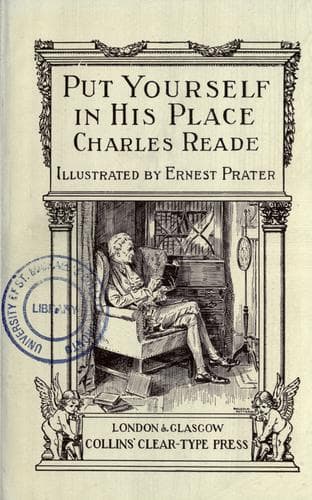
English fiction -- 19th century; Labor unions -- Fiction
Then there was a loud clatter of rising feet, oaths, threats, and even a
knife or two drawn; and, in the midst of it all, the ominous click of a
pistol, and then dead silence; for it was Ransome who had produced that
weapon. “Come, no nonsense,” said he. “Door's guarded, street's guarded,
and I'm not to be trifled with.”
He then handed his pistol to the officer outside with an order, and,
stepping back suddenly, collared Messrs. Holland and Cheetham with one
movement, and, with a powerful rush, carried them out of the house in
his clutches. Meantime the policeman had whistled, there was a conflux
of bobbies, and the culprits were handcuffed and marched off to the Town
Hall.
“Five years' penal servitude for that little lot,” said Ransome.
“And now, Mr. Bolt, I have answered your question to the best of my
ability.”
“You have answered it like a man. Will you do as much for us?”
“I'll do my best. Let me examine the place now that none of them are
about.”
Bolt and Ransome went together, but Little went home: he had an anxiety
even more pressing, his mother's declining health. She had taken to
pining and fretting ever since Dr. Amboyne brought the bad news from
Cairnhope; and now, instead of soothing and consoling her son, she
needed those kind offices from him; and, I am happy to say, she received
them. He never spent an evening away from her. Unfortunately he did not
succeed in keeping up her spirits, and the sight of her lowered his own.
At this period Grace Carden was unmixed comfort to him; she encouraged
him to encroach a little, and visit her twice a week instead of once,
and she coaxed him to confide all his troubles to her. He did so; he
concealed from his mother that he was at war with the trade again, but
he told Grace everything, and her tender sympathy was the balm of his
life. She used to put on cheerfulness for his sake, even when she felt
it least.
One day, however, he found her less bright than usual, and she showed
him an advertisement--Bollinghope house and park for sale; and she was
not old enough nor wise enough to disguise from him that this pained
her. Some expressions of regret and pity fell from her; that annoyed
Henry, and he said, “What is that to us?”
“Nothing to you: but I feel I am the cause. I have not used him well,
that's certain.”
Henry said, rather cavalierly, that Mr. Coventry was probably selling
his house for money, not for love, and (getting angry) that he hoped
never to hear the man's name mentioned again.
Grace Carden was a little mortified by his tone, but she governed
herself and said sadly, “My idea of love was to be able to tell you
every thought of my heart, even where my conscience reproaches me a
little. But if you prefer to exclude one topic--and have no fear that it
may lead to the exclusion of others--”
Public-domain text, read in full here on John Shaqi.
Reviews
Reviews
No reviews yet
Be the first to share your thoughts on this work.
Elsewhere in the archive
Join the Discussion
Join the discussion
Sign in to leave a comment or review.
Sign InorCreate an account