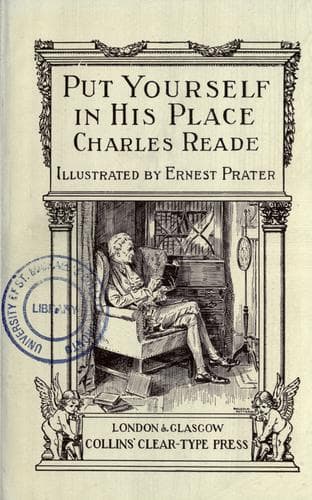
English fiction -- 19th century; Labor unions -- Fiction
These words of fire set Henry pondering deeply; and, as he pondered,
Bayne stuck to the port, and so effectually, that, at last, after an
interval of silence, he came out in a new character. He disturbed his
companion's reverie by informing him, in a loud, aggressive tone, that
it had long been his secret wish to encounter the Hillsborough Trades,
in the persons of their secretaries, under the following conditions: a
twenty-four feet ring, an experienced referee, and a kingdom looking
on. As to the order of the pugilistic events, he was not unreasonably
fastidious; must stipulate to begin with old Smitem; but, after that,
they might encounter their fate in any order they chose, one down
t'other come on. He let him know that this ardent desire for single
combats, in an interminable series, arose from their treatment of his
friend--“the best friend--the best heart--oh!--the best company--oh!
oh!--the best--oh! oh! oh!” Whereupon he wept, the bellicose Bayne. And,
after weeping the usual quantity, he twaddled, and, after twaddling, he
became as pacific as ever, for he went to sleep in his chair.
And, while he snoozed, the words he had uttered set his friend's brain
boiling and bubbling.
When the time came at which Bayne ought to return to the works, Henry
called the landlady, and said, “Mr. Bayne is not very well. I am going
to make his excuses. I wouldn't disturb him till five, if I was you, and
then I'd give him a strong cup of tea.”
Henry then went direct to the office, and found Mr. Cheetham there.
“Well?” said Mr. Cheetham, rather surlily.
“I am come to ask for my month, sir.”
“So I guessed. Do you really mean to exact that?”
“Why not, sir?”
“Haven't you heard how they ground me down?”
“Yes, sir. But why did you give in? I was true to you, but you failed
me. I'd have shut up the works for three months, rather than be made a
slave of, and go from my word.”
“Ay, ay; that's bachelor's talk. I've got a wife and children, and they
make a man a mouse.”
“Well, sir, I forgive you: but as to my month's wages--now all I say
is--PUT YOURSELF IN MY PLACE!”
“Well?”
“You are me. You are brought from London, under an agreement, a
month's notice on either side. You work, and give satisfaction. You are
threatened, but you don't run from your employer. You are blown up,
and nearly killed. You lose a fortnight, but you don't charge for it;
'twasn't your employer's fault. You come back to him, and face the music
again. You work with the sword hanging over you. But your employer gives
in, and sacks you in a minute. Oughtn't you to have your month? Come
now, man to man, oughtn't you?”
“I ought, and that's the truth. I didn't look at it that way. I saw
my own side. There--no more about it--I'll draw the check--with a good
heart.”
He drew his check-book to him, with a face as if vultures were tearing
his vitals.
Public-domain text, read in full here on John Shaqi.
Reviews
Reviews
No reviews yet
Be the first to share your thoughts on this work.
Elsewhere in the archive
Join the Discussion
Join the discussion
Sign in to leave a comment or review.
Sign InorCreate an account