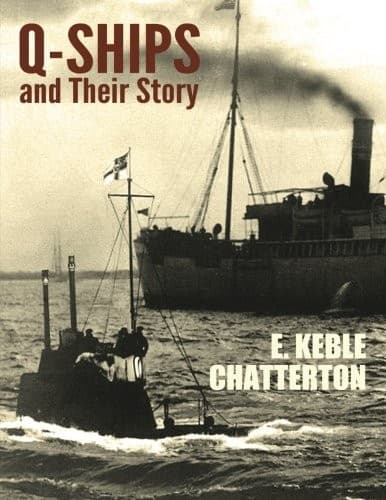
Q-Ships and Their StoryChatterton, E. Keble (Edward Keble)
History
Q-Ships and Their Story
Chatterton, E. Keble (Edward Keble)
Q-ships; World War, 1914-1918 -- Naval operations
But after all that could be prepared for has been done, there
always remains some awkward possibility which the wit of man can
never foresee. Take the incident of the Q-ship _Ravenstone_, which
was commissioned as a Q-ship on June 26, 1917, under the name of
_Donlevon_. A month later she was torpedoed one afternoon in the
Atlantic, 40 miles south of the Fastnet. Fortunately there were no
casualties, and fortunately, too, the ship did not straight away
founder. There was a heavy sea running, and she was soon down by
the head; but she was also prevented from using her engines, for the
torpedo had struck her in No. 2 hold, and the force of the explosion
had lifted and thrown overboard from the fore well-deck a 7-inch hemp
hawser. This had fallen into the sea, floated aft, and there fouled
the propeller so effectually that the ship could go neither ahead
nor astern. It was a most annoying predicament, but who could have
foreseen it? The submarine apparently ‘hopped it,’ for she made no
further attack, and one of Admiral Bayly’s sloops, H.M.S. _Camelia_,
stood by _Donlevon_, and from Berehaven arrived the tug _Flying Spray_,
who got her in tow. Another sloop, the _Myosotis_, had her in tow for
thirty-one hours, handling her so well in the heavy sea that, in spite
of _Donlevon_ being down by the head and steering like a mad thing,
she safely arrived in Queenstown, and was afterwards paid out of the
Service. Ten thousand pounds’ worth of damage had been done.
In the early summer of 1917, at a time when the United States Navy had
just begun to help us with their destroyers and the enemy was hoping
very shortly to bring us ‘to our knees,’ we had thirteen different
Q-ships based on Queenstown. There was the converted sloop _Aubrietia_,
commanded by Admiral Marx, M.V.O., D.S.O., who, in spite of his years,
had come back to the Service and accepted a commission as captain
R.N.R. For a time he was in command of H.M. armed yacht _Beryl_,
owned by Lord Inverclyde. From this command he transferred to the
more exciting work of decoying submarines, and it is amusing when one
thinks of an admiral pretending to be the skipper of a little tramp. Of
this thirteen there was Captain Grenfell’s _Penshurst_, about which
the reader has already been informed. Captain Gordon Campbell was in
_Pargust_, and Commander Leopold A. Bernays, C.M.G., was in _Vala_. The
latter was one of the most unusual personalities in a unique service.
Before the war he had left the Navy and gone to Canada, where he had
some pretty tough adventures. On the outbreak of war he joined up, and
crossed to England as a soldier, but managed to get transferred quite
early to a mine-sweeping trawler, where he did magnificent work month
after month; first in sweeping up the mine-field laid off Scarborough
at the time of the German raid, December, 1914, and afterwards in
clearing up the difficult Tory Island minefield, which had been laid by
Public-domain text, read in full here on John Shaqi.
Reviews
Reviews
No reviews yet
Be the first to share your thoughts on this work.
Elsewhere in the archive
Join the Discussion
Join the discussion
Sign in to leave a comment or review.
Sign InorCreate an account