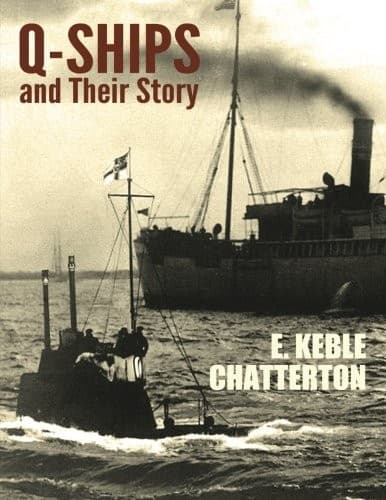
Q-Ships and Their StoryChatterton, E. Keble (Edward Keble)
History
Q-Ships and Their Story
Chatterton, E. Keble (Edward Keble)
Q-ships; World War, 1914-1918 -- Naval operations
If, in accordance with the delightful legend, Drake during the
recent war had heard the beating of his drum and had ‘quit the port
o’ Heaven,’ come back to life again in the service of his Sovereign
and country, he would assuredly have gone to sea in command of a
Q-sailing-ship. His would have been the Victoria Cross and D.S.O. with
bars, and we can see him bringing his much battered ship into Plymouth
Sound as did his spiritual descendants in the Great War. And yet, with
all the halo of his name, it is impossible to imagine that, great
seaman as he was, his deeds would be more valiant than those we are now
recording.
If we had, so to speak, put the clock back by the re-introduction
of the fighting sailing ship, it was an anachronism that was well
justified by results. More of these craft and various rigs were still
being taken up. In the spring of 1917 the topsail schooner _Dargle_ was
requisitioned, fitted out at Granton with a 4-inch and two 12-pounders,
and then sent to Lerwick, whence she operated. Similarly the ketch
_George L. Muir_ (alias _G. L. Munro_, _G.L.M._, and _Padre_), which
was accustomed to trade between Kirkwall and the Firth of Forth, was
chartered and armed with a 12-pounder.
On April 22, 1917, the 174-ton auxiliary barquentine _Gaelic_
(otherwise known as _Brig 11_, _Gobo_, and Q 22), which had been taken
up at the end of 1916, and was armed with a couple of 12-pounders, had
a very plucky fight. She had left Falmouth on the nineteenth under
the command of Lieutenant G. Irvine, R.N.R., and at 6.30 p.m. was now
48 miles south of the Old Head of Kinsale, steering S.E. under all
fore-and-aft sail. It was a fine, clear day, the sea was calm, there
was little wind, but the ship was making about 2 knots under sail and
starboard motor. It was a quiet Sunday evening: one of those gentle
spring days which came gladly to the Irish coast after the long nights
and continuous gales of the dark winter. The watch, consisting of four
men, were all aloft getting in the square sails, when one of them
hailed the deck that he could see a submarine about four points on the
starboard bow. She was distant about 5,000 yards to the southward and
steering to the N.W. at slow speed.
Public-domain text, read in full here on John Shaqi.
Reviews
Reviews
No reviews yet
Be the first to share your thoughts on this work.
Elsewhere in the archive
Join the Discussion
Join the discussion
Sign in to leave a comment or review.
Sign InorCreate an account