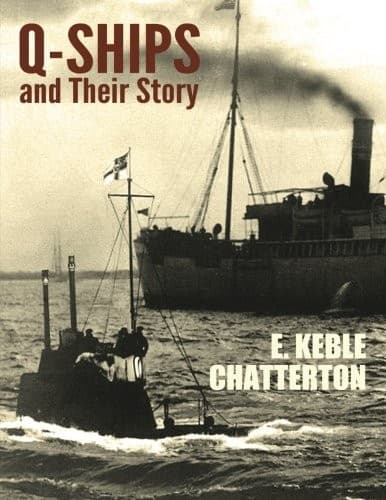
Q-Ships and Their StoryChatterton, E. Keble (Edward Keble)
History
Q-Ships and Their Story
Chatterton, E. Keble (Edward Keble)
Q-ships; World War, 1914-1918 -- Naval operations
Sometimes victory was conditional only on being torpedoed, so that
the enemy might believe he had got the steamer in a sinking condition
and the vessel was apparently genuinely abandoned. Inasmuch as the
submarine on returning home had to afford some sort of evidence, the
U-boat captain would approach the ship and endeavour to read her
name. It was then that the Q-ship’s opportunity presented itself, and
the guns poured shells into the German. Special drills were therefore
made in case _Penshurst_ should be hit by torpedo, and in this
eventuality the boat ‘panic party’ was to lower away and at once
start rowing off from the ship, whilst the remainder hid themselves
at their respective stations. As for the engineers, their duty was to
stop the engines at once, but to try to keep the dynamo running as
long as possible so that wireless signals could still be sent out.
The engine-room staff were to remain below as long as conditions
would allow, but if the water rose so that these were compelled to
come up, their orders were to crawl out on to the deck on the
disengaged side and there lie down lest the enemy should see them. As
these Q-ships usually carried depth charges and the latter exploded
under certain conditions of pressure from the sea, it was one of the
first duties on being torpedoed that these should be secured.
Now, supposing the Q-ship were actually sunk and the whole crew were
compelled _really_ to abandon ship, what then? The submarine would
certainly come alongside the boats and make inquiries. She would want
to know, for instance, the name of the ship, owners, captain, cargo,
where from, where bound. That was certain. She would also, most
probably, insist on taking the captain prisoner, if the incident
occurred in the last eighteen months of the war. All these officers
and men would, of course, be wearing not smart naval uniform, but be
attired in the manner fitting the _personnel_ of an old tramp. The
captain would be wearing a peaked cap, with the house-flag of his
Company suitably intertwined in the cap badge, while the men would be
attired in guernseys, old suits, and mufflers, with a dirty old cloth
cap. Now, if the U-boat skipper was a live man and really knew his
work he would, of course, become suspicious on seeing so many hands
from one sunken tramp. ‘This,’ he would remark, ‘is no merchant ship,
but a proper trap,’ and would proceed to cross-examine the boats’
crews. It was therefore the daily duty of Q-ship men to learn a
suitable lie which would adequately deceive the German. Here is the
information which _Penshurst_ was, at a certain period of her Q-ship
career, ready to hand out to any inquisitive Hun if the latter had
sunk the ship.
Public-domain text, read in full here on John Shaqi.
Reviews
Reviews
No reviews yet
Be the first to share your thoughts on this work.
Elsewhere in the archive
Join the Discussion
Join the discussion
Sign in to leave a comment or review.
Sign InorCreate an account