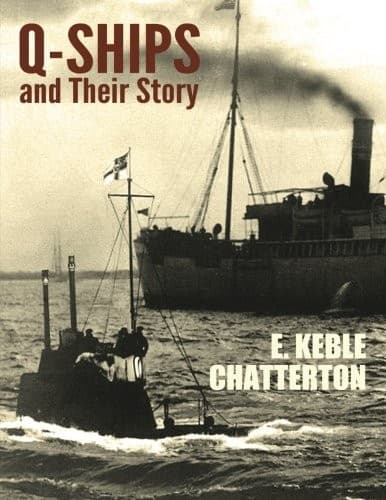
Q-Ships and Their StoryChatterton, E. Keble (Edward Keble)
History
Q-Ships and Their Story
Chatterton, E. Keble (Edward Keble)
Q-ships; World War, 1914-1918 -- Naval operations
‘I then “spliced the main-brace.” We passed the S—— Light at 11.30
p.m., and just before picking up the Examination boat received a
wireless message from [the Commander-in-Chief], which reads: “Very well
done. A year’s perseverance well rewarded.”... We anchored at midnight,
and a boat at once came off with a doctor, who removed the wounded....
A tug brought off the armed guard sent ... to receive our prisoners....
We formally mustered the prisoners and handed them over, with the
signing of receipts for their custody and disposal, etc. It was an
impressive moment when I led the officer in charge to the saloon, and
handed over to him the commanding officer of the submarine. A couple of
bluejackets with rifles fixed promptly closed up at either elbow, and
he was marched out. He had the grace to pause at the door, where I was
standing, and to thank me for my treatment of him. He was no doubt very
much upset by the loss of his ship: we found him extremely glum and did
our best to cheer him up. He had lunch with us, and I think he really
did find that we were human. Similarly the other officers tendered
their thanks (they all went away in a good deal of our clothing),
and when it came to the marching off of the men, —— stepped out of
the ranks and tendered to me their grateful thanks for the excellent
treatment they had received at our hands.’
CHAPTER XVIII
THE LAST PHASE
One of the effects of the British blockade on Germany was to prevent
such valuable war material as iron reaching Germany from Spain. Now
Spanish ores, being of great purity, were in pre-war days imported in
large quantities for the manufacture of the best qualities of steel,
and it was a serious matter for Germany that these importations were
cut off. But luckily for her she had been accustomed to obtain, even
prior to the war, supplies of magnetic ore from Sweden, and it was of
the utmost importance that this should be continued now that the war
would last much longer than she had ever expected.
If you look at a map of Scandinavia inside the Arctic Circle you will
notice the West Fjord, which is between the Lofoten Isles and the
Norwegian mainland. Follow this up and you come to the Ofoten Fjord, at
the head of which is the Norwegian port of Narvik. From here there ran
across the Swedish border to Lulea what was the most northerly railway
in Europe, and Narvik was a great harbour for the export of magnetic
iron ore. Hither German ships came, loaded, and then, by keeping within
the three-mile limit of territorial waters, going inside islands, and
taking every possible advantage of night, managed to get their valuable
cargoes back home for the Teutonic munition makers.
Public-domain text, read in full here on John Shaqi.
Reviews
Reviews
No reviews yet
Be the first to share your thoughts on this work.
Elsewhere in the archive
Join the Discussion
Join the discussion
Sign in to leave a comment or review.
Sign InorCreate an account