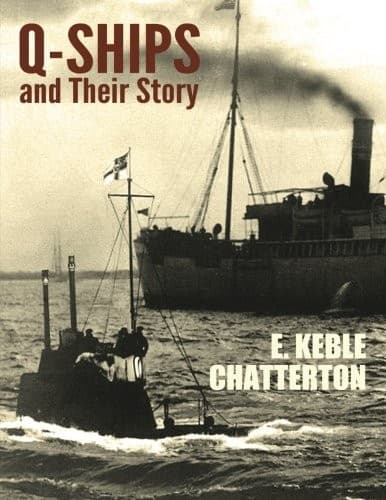
Q-Ships and Their StoryChatterton, E. Keble (Edward Keble)
History
Q-Ships and Their Story
Chatterton, E. Keble (Edward Keble)
Q-ships; World War, 1914-1918 -- Naval operations
us the loss of a small coaster turned temporarily into a man-of-war was
of little consequence. A similar ship, the _Suffolk Coast_, would soon
be picked up and then turned over to the dockyard experts to be fitted
out; but in the case of a submarine there were only limited numbers.
That particular U-boat would now have a long list of defects and be a
non-combatant for a long time, and her crew would morally be seriously
affected by their miraculous escape, and they would not forget to pass
on their impressions to their opposite numbers in other submarines.
It was rather the cumulative effect of Q-ships, destroyers, mines,
auxiliary patrol craft, depth charges, hydrophones, convoys, and good
staff work which broke the spirit of the German submarine menace, so
that if the war had continued much longer U-boats would have been
thwarted except within certain limits of the North Sea. Every weapon
has its rise and fall in the sphere of usefulness; the shell is
repelled by armour-plate, the Zeppelin is destroyed by the aircraft,
and so on. So it was with the Q-ship. It came into being at a time when
no other method seemed likely to deal with submarines adequately. It
became successful, it rose into popularity to its logical peak, and
then began to wane in usefulness as the submarine re-adapted herself
to these new conditions. Afterwards came the period when the mine
barrages in the Heligoland Bight, in the Dover Strait, and across the
northern end of the North Sea, and the hydrophones, in swiftly moving
light craft, made the life of any submarine precarious in his going and
coming. The hydrophone has made such wonderful developments since the
war that in the future within the narrow seas a submarine would find
life a little too thrilling to be pleasant.
Public-domain text, read in full here on John Shaqi.
Reviews
Reviews
No reviews yet
Be the first to share your thoughts on this work.
Elsewhere in the archive
Join the Discussion
Join the discussion
Sign in to leave a comment or review.
Sign InorCreate an account