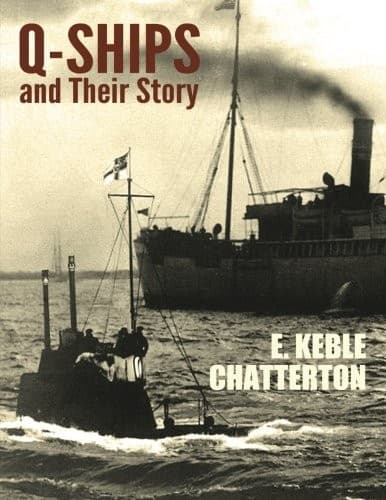
Q-Ships and Their StoryChatterton, E. Keble (Edward Keble)
History
Q-Ships and Their Story
Chatterton, E. Keble (Edward Keble)
Q-ships; World War, 1914-1918 -- Naval operations
In order properly to appreciate the difficulties of the Q-ships,
it is necessary to understand something of the possibilities and
limitations of the U-boats. No one could hope to be successful with
his Q-ship unless he realized what the submarine could not do, and how
he could attack the U-boat in her weakest feature. If the submarine’s
greatest capability lay in the power of rendering herself invisible,
her greatest weakness consisted in remaining thus submerged for a
comparatively short time. On the surface she could do about 16 knots;
submerged, her best speed was about 10 knots. As the heart is the vital
portion of the human anatomy, so the battery was the vital part of the
submarine’s invisibility. At the end of a couple of hours, at the most,
it was as essential for her to rise to the surface, open her hatches,
and charge her batteries as it is for a whale or a porpoise to come up
and breathe. It was the aim, then, of all anti-submarine craft to use
every endeavour to keep the U-boat submerged as long as possible. Those
Q-ships who could steam at 10 knots and over had a good chance then of
following the submarine’s submerged wake and despatching her with depth
charges. If she elected not to dive, there was nothing for it but to
tempt her within range and bearing of your guns and then shell her. To
ram was an almost impossible task, though more than one submarine was
in this way destroyed.
The difficulty of anti-submarine warfare was increased when the enemy
became so wary that he preferred to remain shelling the ship at long
range, and this led to our Q-ships having to be armed with at least one
4-inch against his 4·1-inch gun. The famous Arnauld de la Périère, who,
in spite of his semi-French ancestry, was the ablest German submarine
captain in the Mediterranean, was especially devoted to this form of
tactics. Most of the German submarines were double-hulled, the space
between the outer and inner hulls being occupied by water ballast and
oil fuel. The conning-tower was literally a superstructure imposed over
the hull, and not an essential part of the ship. That is why, as we
have already seen, the Q-ship could shell holes into the tower and yet
the U-boat was not destroyed. Similarly, a shell would often pierce the
outer hull and do no very serious damage other than causing a certain
amount of oil to escape. Only those who have been in British and German
submarines, and have seen a submarine under construction, realize what
a strong craft she actually is.
Public-domain text, read in full here on John Shaqi.
Reviews
Reviews
No reviews yet
Be the first to share your thoughts on this work.
Elsewhere in the archive
Join the Discussion
Join the discussion
Sign in to leave a comment or review.
Sign InorCreate an account