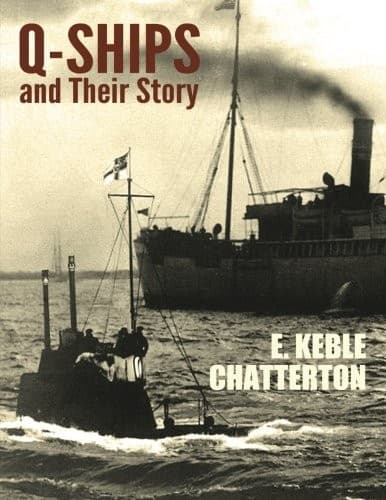
Q-Ships and Their StoryChatterton, E. Keble (Edward Keble)
History
Q-Ships and Their Story
Chatterton, E. Keble (Edward Keble)
Q-ships; World War, 1914-1918 -- Naval operations
The ideal submarine would weigh about the same amount as the water
surrounding her. That being a practical impossibility, before she
submerges she is trimmed down by means of water ballast, but then
starts her engines and uses her planes for descent in the same way
as an aeroplane. The flooding tanks, as we have seen, are between
the two hulls, and the hydroplanes are in pairs both forward and
aft. The U-boat has been running on the surface propelled by her
internal-combustion motors. Obviously these cannot be used when she
is submerged, or the air in the ship would speedily be used up.
When about to submerge, the German captain trimmed his ship until
just afloat; actually he frequently cruised in this trim when in the
presence of shipping, ready to dive if attacked. The alarm was then
pressed, the engineer pulled out the clutch, the coxswain controlling
the forward hydroplane put his helm down, the captain entered the
conning-tower, the hatch was closed, and away the steel fish cruised
about beneath the surface.
The U-boat was now running on her electric batteries. By means of two
periscopes a view was obtained not merely of the sea above, but also
of the sky, so that surface craft and aircraft might be visible. The
order would be given to submerge to say 10 metres. Alongside each of
the two coxswains was a huge dial marked in metres, and it was the
sole duty of these two men to watch the dials, and by operating a big
wheel controlling each hydroplane maintain the submarine at such a
depth. Horizontal steering was done also by a wheel, and course kept
by means of a gyroscope compass, a magnetic compass in this steel ship
with so much electricity about being out of the question. The batteries
were charged while the submarine was on the surface by turning the oil
engines into a dynamo by means of the clutch, the hour before dawn and
the hour after sunset being favourable times for so charging.
Public-domain text, read in full here on John Shaqi.
Reviews
Reviews
No reviews yet
Be the first to share your thoughts on this work.
Elsewhere in the archive
Join the Discussion
Join the discussion
Sign in to leave a comment or review.
Sign InorCreate an account