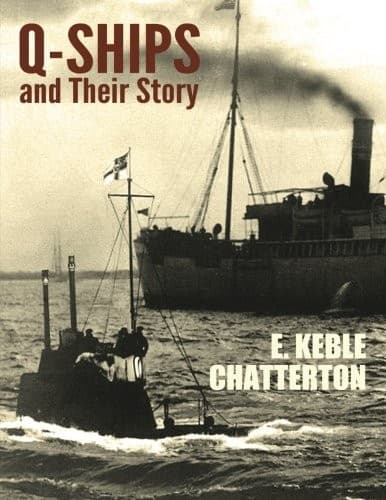
Q-Ships and Their StoryChatterton, E. Keble (Edward Keble)
History
Q-Ships and Their Story
Chatterton, E. Keble (Edward Keble)
Q-ships; World War, 1914-1918 -- Naval operations
to the imagination only by means of a Théâtre Guignol play.
It was the obvious duty of the Q-ships to make the life of a U-boat as
nearly as possible unbearable, and thus save the lives of our ships
and men of the Mercantile Marine. It was no easy task, and even with
perfect organization, well-thought-out tactics, and well-trained crews,
it would happen that something would rob the decoy of her victory.
On October 20, 1916, for instance, the Q-ship _Salvia_, one of the
sloop-class partially reconstructed with a false counter-stern to
resemble a 1,000-ton tramp, was off the west coast of Ireland when a
submarine appeared astern, immediately opened fire, and began to chase.
_Salvia_ stopped her engines to allow the enemy to close more rapidly,
but the U-boat, observing this, hauled out on to the Salvia’s starboard
quarter, and kept up her firing without shortening the range of 2,000
yards. _Salvia_ next endeavoured to close the range by going slow ahead
and altering slightly towards the enemy, but the latter’s fire was
now becoming so accurate that _Salvia_ was soon hit on the starboard
side by a 4·1-inch high-explosive shell. This burst through in nine
places in the engine-room bulkhead, smashing an auxiliary steam-pipe
and causing a large escape of steam. The engines were now put full
ahead, and course was made for the enemy, who sheered away and shortly
afterwards dived.
[Illustration: FIG. 7.—DIAGRAM TO ILLUSTRATE APPROXIMATE MOVEMENTS OF
‘SALVIA’ IN HER ACTION WITH SUBMARINE ON OCTOBER 20, 1916.]
That being so, _Salvia_ deemed it prudent to pretend to run away, but
in the middle of the evolution her steering gear unfortunately broke
down, and before control was established again with hand-steering
gear, the ship had swung 90 degrees past her course, and the submarine
reappeared on the port beam about 1,500 yards away, but presently
disappeared. The breakdown had been most unfortunate, for otherwise
a short, sharp action at about 700 yards would have been possible,
followed by an excellent chance of dropping a depth charge very close
to the enemy. In that misty weather, with a rough sea and a fairly
strong breeze, it had been difficult to see any part of the U-boat’s
hull, for she had trimmed herself so as to have little buoyancy, and
only her conning-tower could be discerned. Below, in the Q-ship, the
engine-room staff found themselves up against difficulties; for it was
an awkward job repairing the leaking steam-pipe, as the cylinder tops
and the engine-room were full of live steam and lyddite fumes. The
chief artificer and a leading stoker were overcome by the fumes, but
the job was tackled so that steam could be kept up in the boilers.
Public-domain text, read in full here on John Shaqi.
Reviews
Reviews
No reviews yet
Be the first to share your thoughts on this work.
Elsewhere in the archive
Join the Discussion
Join the discussion
Sign in to leave a comment or review.
Sign InorCreate an account