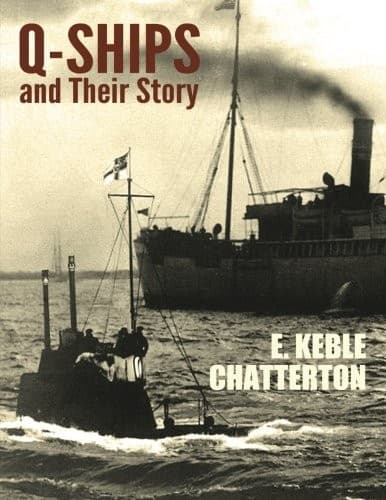
Q-Ships and Their StoryChatterton, E. Keble (Edward Keble)
History
Q-Ships and Their Story
Chatterton, E. Keble (Edward Keble)
Q-ships; World War, 1914-1918 -- Naval operations
We have seen that the U-boat sought to disguise herself by putting
up a sail when in the vicinity of fishing craft or patrol vessels.
The submarine which torpedoed one ship disguised her periscope by
a soap box, so that it was not realized till too late that this
innocent-looking box was floating _against_ the tide. At the best the
submarine was an unhandy craft, and it took her from three to six
minutes to make a big alteration of course, inasmuch as she had to
dive deeper lest she should break surface or disturb the surface of
the water. Again, when running submerged, if she wished to turn 16
points—_e.g._, from north to south—the pressure on her hull made it
very difficult.
It may definitely be stated that those who went to their doom in
U-boats had no pleasant death. When the Q-ship caused the enemy to be
holed so that he could not rise and the water poured in, this water,
as it moved forward in the submarine, was all the time compressing
the air, and those of the crew who had not already committed suicide
suffered agonies. Moreover, even if a little of the sea got into
the bilges where the batteries were placed there was trouble also.
Sea-water in contact with the sulphuric acid generated chlorine, a very
deadly gas, which asphyxiated the crew. There is at least one case on
record of a U-boat surrendering to a patrol boat in consequence of
his crew having become incapacitated by this gas; and on pulling up
the floorboards of a British submarine, one has noticed the chlorine
smell very distinctly. The dropping by the decoy ship of depth charges
sometimes totally destroyed the submarine, but even if this was not
accomplished straight away, it had frequently a most salutary effect:
for, at the least, it would start some of the U-boat’s rivets, smash
all the electric bulbs in the ship, and put her in total darkness. The
nasty jar which this and the explosion gave to the submarine’s crew
had a great moral effect. A month’s cruise in a submarine in wintry
Atlantic weather, hunted and chased most of the way from Heligoland
to the Fastnet and back, is calculated to try any human nerves: but
to be depth-charged periodically, or surprised and shelled by an
innocent-looking tramp or schooner, does not improve the enthusiasm of
the men. Frequently it happened that the decoy ship’s depth charges
merely put the hydroplanes out of gear so that they jammed badly.
The U-boat would then make a crash-dive towards the bottom. At 100
feet matters became serious, at 200 feet they became desperate; and
presently, owing to pressure, the hull would start buckling and
leaking. Then, by sheer physical strength, the hydroplanes had to be
coaxed hard over, and then up would come the U-boat to the surface,
revealing herself, and an easy prey for the Q-ship’s guns, who would
finish her off in a few fierce minutes. Life in a U-boat was no picnic,
but death was the worst form of torture, and such as could be conveyed
Public-domain text, read in full here on John Shaqi.
Reviews
Reviews
No reviews yet
Be the first to share your thoughts on this work.
Elsewhere in the archive
Join the Discussion
Join the discussion
Sign in to leave a comment or review.
Sign InorCreate an account