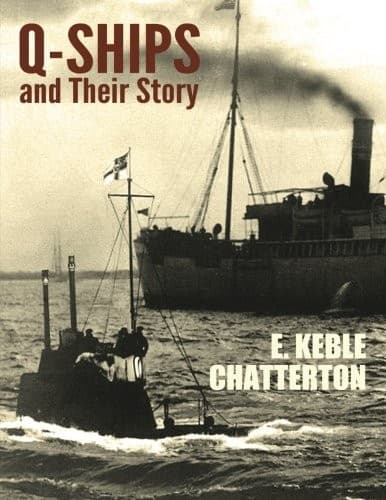
Q-Ships and Their StoryChatterton, E. Keble (Edward Keble)
History
Q-Ships and Their Story
Chatterton, E. Keble (Edward Keble)
Q-ships; World War, 1914-1918 -- Naval operations
In the Mediterranean the enemy was showing an increased caution against
likely decoys, and by the beginning of December, 1916, had already
sunk a couple of Q-ships. The Q-ship _Saros_ (Lieut.-Commander R. C.
C. Smart) was operating in this sea, and had an engagement on October
30, thirteen miles from Cape San Sebastian. The engine-room was ordered
to make smoke, as though the stokers were endeavouring to get the
utmost speed out of the ship: at the same time the engines were rung
down to ‘slow.’ But the enemy realized the ruse and slowed down, too.
Lieut.-Commander Smart endeavoured to make the enemy think a panic
had seized the ship. So the firemen off watch were sent below to put
on lifebelts and then to man the boats. Stewards ran about, placing
stores and blankets in the boats, but the enemy insisted on shelling,
so _Saros_ had to do the same, whereupon the submarine’s guns’ crews
made a bolt for the inside of the U-boat, and then made off. As soon
as she had got out of sight, _Saros_ changed her disguise, taking the
two white bands off the funnel, hoisting Spanish colours, and altering
course for the Spanish coast.
[Illustration: FIG. 8.—DIAGRAM TO ILLUSTRATE APPROXIMATE MOVEMENTS OF
‘SAROS’ IN HER ACTION WITH SUBMARINE ON NOVEMBER 3, 1916.]
Three days later _Saros_ was returning to the Gibraltar-Malta shipping
track, heading for the Cani Rocks, after carrying out firing exercises.
At half-past four in the afternoon, the officer of the watch heard a
shot, and saw a submarine 7,000 yards off on the starboard beam. She
was not trimmed for diving, and was apparently trimmed to cruise like
this during the night on the surface. She seemed quite careless and
slow about her movements, evidently never suspecting _Saros’_ true
character. _Saros_ altered course towards the enemy, who was firing
all the time, one round exploding and falling on board and several
coming close over the bridge. The U-boat, after going on an opposite
course, very slowly turned to starboard to get on a parallel course,
and men were seen hoisting up ammunition on deck. The light was bad,
and it was becoming late, but _Saros_ had manœuvred to get the German
in a suitable position as regards the sun, so at 5,500 yards range
opened fire with her 4-inch and 12-pounder at 4.44 p.m. This shocked
the Teuton, so that the crew which had been sitting around smoking, and
apparently criticizing the old ‘merchantman,’ suddenly became active,
lowered the wireless masts and disappeared below. By the tenth round,
the enemy, who appeared to have been hit, dived, and at 4.50 p.m.
_Saros_ ceased fire. Course was then altered to where she had last been
seen, and just before turning, the enemy for a moment showed himself,
but as the gun-layer was ready the German disappeared, and then
artfully cruised about submerged, so as to get in a good position. She
was never seen again, but at 5.15 p.m. a torpedo passed just ahead of
the _Saros_, and thereafter the latter zigzagged at her utmost speed.
Public-domain text, read in full here on John Shaqi.
Reviews
Reviews
No reviews yet
Be the first to share your thoughts on this work.
Elsewhere in the archive
Join the Discussion
Join the discussion
Sign in to leave a comment or review.
Sign InorCreate an account