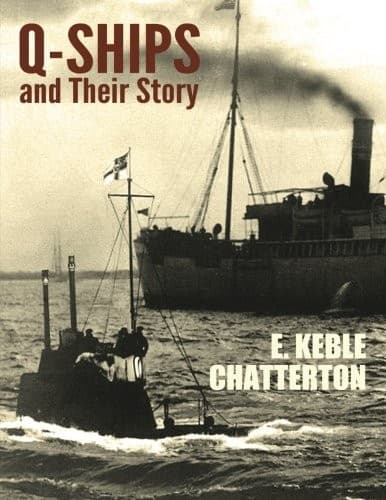
Q-Ships and Their StoryChatterton, E. Keble (Edward Keble)
History
Q-Ships and Their Story
Chatterton, E. Keble (Edward Keble)
Q-ships; World War, 1914-1918 -- Naval operations
On November 9, 1915, the Admiralty, who had taken up the steamer
_Penshurst_ (1,191 gross tons), commissioned her at Longhope as a
Q-ship, her aliases being Q 7 and _Manford_. This inconspicuous-looking
vessel thus began a life far more adventurous than ever her designers
or builders had contemplated. Indeed, if we were to select the three
Q-ships which had the longest and most exciting career, we should
bracket _Penshurst_ with _Farnborough_ and _Baralong_.
The following incidents illustrate that no particular rule could be
laid down as to when a Q-ship could get in touch with the enemy. We
have seen that _Baralong_ set forth for a particular locality to
look for a definite submarine and found her. Other decoys searched
for submarines but never so much as sighted one; others, again, when
everything seemed quiet, suddenly found themselves torpedoed and
sinking. Others, too, had an engagement to-day, but their next fight
did not come until a year later. The case of _Penshurst_ is interesting
in that on two consecutive days she fought a submarine, but she is
further interesting as having been commanded by an officer who, with
Captain Gordon Campbell, will always remain the greatest of all Q-ship
captains.
[Illustration: FIG. 9.—DIAGRAM TO ILLUSTRATE APPROXIMATE MOVEMENTS OF
‘PENSHURST’ IN HER ENGAGEMENT WITH SUBMARINE ON NOVEMBER 29, 1916.]
Commander F. H. Grenfell, R.N., was a retired officer who, like so many
others, had come back to the service after the outbreak of war. After
serving for a year in the 10th Cruiser Squadron as second-in-command
of _Cedric_, he was appointed to command _Penshurst_, cruised up and
down first off the north of Scotland, then off Ireland, and in the
English Channel for nearly a year without any luck. On November 29,
1916, a year after her advent into this special service, _Penshurst_,
who, with her three masts, low freeboard, and funnel aft, resembled
an oil-tanker, was steaming down the English Channel at 8 knots. The
time was 7.45 a.m., and her course was S. 81 W. (Mag.), her position
at this time being Lat. 49.45 N., Long. 4.40 W. She was definitely on
the look-out for a certain submarine which had been reported at 4.30
the previous afternoon in Lat. 50.03 N., Long. 3.38 W. As _Penshurst_
went jogging along, picture a smooth sea, a light south-west wind,
and the sun just rising. Fine on the port bow 7 miles away was the
British merchant steamer _Wileyside_, armed, as many ships were at this
time, defensively with one gun aft; while hull down on _Penshurst’s_
starboard bow was a sailing ship of sorts. Then, of a sudden, a small
object was sighted on the port beam against the glare of the horizon,
so that it was difficult to make out either its nature or its distance.
However, at 7.52 a.m. this was settled by the object firing a shot and
disclosing herself as a submarine. The shot fell 60 yards short, but a
few minutes later came another which passed over the mainmast without
hitting.
Public-domain text, read in full here on John Shaqi.
Reviews
Reviews
No reviews yet
Be the first to share your thoughts on this work.
Elsewhere in the archive
Join the Discussion
Join the discussion
Sign in to leave a comment or review.
Sign InorCreate an account