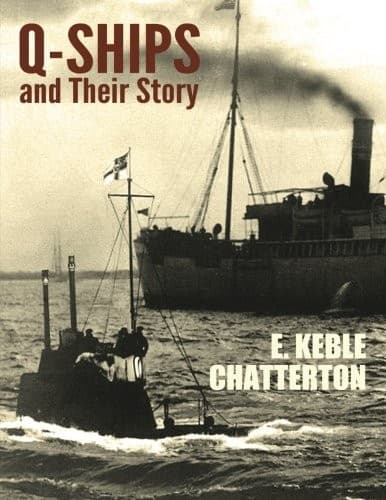
Q-Ships and Their StoryChatterton, E. Keble (Edward Keble)
History
Q-Ships and Their Story
Chatterton, E. Keble (Edward Keble)
Q-ships; World War, 1914-1918 -- Naval operations
[Illustration: FIG. 10.—DIAGRAM TO ILLUSTRATE APPROXIMATE MOVEMENTS OF
‘PENSHURST’ IN HER ACTION WITH SUBMARINE ON NOVEMBER 30, 1916.]
During the forenoon of November 30 we should have seen this transformed
_Penshurst_ going down Channel again well south of the Dorset chalk
cliffs. At noon she was in the position Lat. 50.11 N., Long. 2.31 W.
(see track chart), steering N. 89 W., when she intercepted a wireless
signal from the Weymouth-Guernsey S.S. _Ibex_ that a submarine had been
seen at 11.44 a.m. 20 miles N.W. of the Casquets; so the Q-ship altered
course towards this position, and at 1.50 p.m. the conning-tower
of a submarine was observed 5 miles to the southward, apparently
chasing a steamer to the westward. A few minutes later the German
turned eastward and then submerged. It was then that _Penshurst_ saw
a seaplane, which had come across the Channel from the Portland base,
fly over the submarine’s position and drop a bomb without effect. This
caused Captain Grenfell to reconstruct his plans, for it was hopeless
now to expect that the submarine would engage on the surface. On the
other hand, the Q-ship with her speed would be superior to this type
of submarine, which, when submerged, could not do better than 6 knots
at her maximum, but would probably be doing less than this. The weapon
should, therefore, be the depth charge, and not the gun. He decided to
co-operate with the seaplane, and ran down towards her.
[Illustration: Q SHIP “PENSHURST”
Showing bridge-screen dropped on port side and bridge gun ready for
action.
To face p. 114]
It was necessary first to get in touch with the airman and explain who
the ship was, so at 2.22 p.m., being now in Lat. 50 N., Long. 2.48
W., Captain Grenfell stopped his engines, and after some attempts at
communication by signal, the seaplane alighted on the water alongside.
Captain Grenfell was thus able to arrange with the pilot to direct
the Q-ship and fire a signal-light when the ship should be over the
submarine; a depth charge could then be let go. But the best-laid
schemes of seamen and airmen sometimes went wrong: for, just after the
seaplane had risen into the air, she crashed on to the water, broke a
wing, knocked off her floats and began to sink. This was annoying at a
time when the Q-ship wanted to be thinking of nothing except the enemy;
but _Penshurst_ lowered her gig and rescued the airmen, then went
alongside the injured seaplane, grappled it, and was preparing to hoist
it on board when at 3.14 p.m. a shell dropped into the sea 200 yards
ahead of the ship. Other shots quickly followed, and then the submarine
was sighted about 6,000 yards on the port quarter. How the enemy must
have laughed as, through his periscope, he saw the aircraft which so
recently had been the aggressor, now a wreck! How certain a victim the
innocent-looking steamer seemed to him!
Public-domain text, read in full here on John Shaqi.
Reviews
Reviews
No reviews yet
Be the first to share your thoughts on this work.
Elsewhere in the archive
Join the Discussion
Join the discussion
Sign in to leave a comment or review.
Sign InorCreate an account