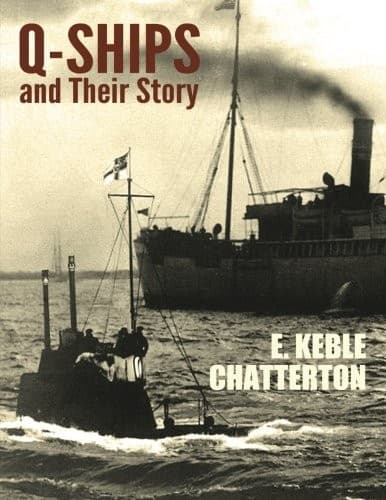
Q-Ships and Their StoryChatterton, E. Keble (Edward Keble)
History
Q-Ships and Their Story
Chatterton, E. Keble (Edward Keble)
Q-ships; World War, 1914-1918 -- Naval operations
But now approached H.M.S. _Alyssum_ from the north and began to shell
the enemy, so that the latter made off to the southward. The speed of
_Penshurst_ was 8 knots—that is to say, about half that of the enemy.
Nor could the sloop overtake the latter, who, after being chased for
three hours, disappeared at 5.12 p.m. These sloops had been built
for mine-sweeping work, and not as anti-submarine ships, and it was
only because of the shortage of destroyers—thanks largely to the
demands in this respect by the Grand Fleet—that these single-screwed,
comparatively slow vessels were engaged on escort and patrol duties.
In this engagement between the Q-ship and submarine everything had
been done that could have been brought about by a most experienced,
skilful, and determined British officer. His guns had kept on hitting,
and yet the enemy had escaped. Fortunately we now know the story
from the enemy’s side, as an account of this incident was published
in the German Press, and bears out all that has been said above. The
German version mentions that U 84 took the British ship for a tank
steamer. This is not in the least surprising, for the _Penshurst_ was
one of those small ships with her engines aft just as you see in an
‘oil-tanker,’ and such a craft was sure enough bait for any submarine.
The Germans say the torpedo was fired at 765 yards range, and missed
because the British ship was going ‘faster than we supposed.’ The
Q-ship’s disguise was perfect, for it was not until she opened
fire that she was suspected of being a ‘trap.’ As to the latter’s
shelling, the German account admits that the superstructure abaft the
conning-tower was at once penetrated, and that hardly had the hatch
been closed than ‘there is a sharp report in the conning-tower, a
yellow flash, and explosive gases fill the air. A shell has penetrated
the side of the conning-tower and exploded inside.’ The result was
that one man was injured. She then dived, and at 65·6 feet they felt
the two depth charges, which made the boat tremble and put out some of
the electric lights. The forward hydroplane jammed, and this was the
reason she came to the surface at such a steep angle. The gyro compass,
the main rudder, the trimming pump, and all the control apparatus also
broke down. But what about the leaks made by the shells? These were
plugged, the tricolour flag of the French sailing ship _Bayonne_, which
they had sunk on February 17 in the English Channel, being also used
for that purpose.
Public-domain text, read in full here on John Shaqi.
Reviews
Reviews
No reviews yet
Be the first to share your thoughts on this work.
Elsewhere in the archive
Join the Discussion
Join the discussion
Sign in to leave a comment or review.
Sign InorCreate an account