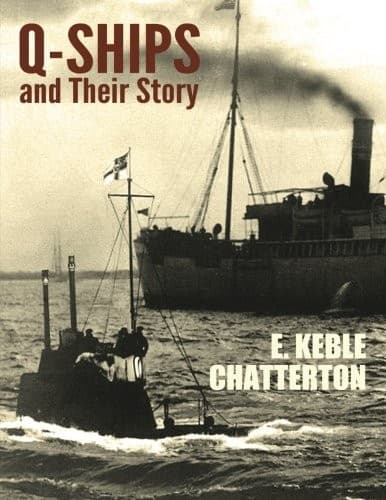
Q-Ships and Their StoryChatterton, E. Keble (Edward Keble)
History
Q-Ships and Their Story
Chatterton, E. Keble (Edward Keble)
Q-ships; World War, 1914-1918 -- Naval operations
The sighting of this little topsail schooner made him avaricious. He
had sunk eleven: why not make the number a round dozen? So, at 8.45
p.m., he altered course towards the _Prize_, and ordering on deck to
see the fun all his men who could be spared, he opened fire with both
guns. Lieutenant Sanders therefore brought _Prize_ into the wind, and
sent his panic party to row about. This party consisted of six men
in charge of Skipper Brewer, of the Trawler Reserve, who had been
intentionally visible on deck, and now launched their small boat. In
the meantime, at the sounding of the alarm, Lieutenant Sanders and
Skipper Meade (also of the Trawler Reserve) had concealed themselves
inside the steel companion-cover amidships, and the rest of the crew
were hiding under the protection of the bulwarks or crawling to their
respective stations. _Prize’s_ two guns were placed one forward,
concealed by a collapsible deckhouse, and one aft, on an ingenious
disappearing mounting under the hatchway covers of the after hold,
and she carried also a couple of Lewis guns. Lieutenant W. D. Beaton,
R.N.R., who was second in command of the ship, was in charge of the
gunnery forward, and lay at the foot of the foremast with his ear to a
voice-pipe which led back to where Lieutenant Sanders was conning the
ship.
The contest could not fail to be interesting, for it resolved itself
into a duel between one ‘star-turn’ artist and another. Neither was a
novice, both were resourceful, plucky men, and the incident is one of
the most picturesque engagements of all the Q-ship warfare. Taking it
for granted that this little trader out in the Atlantic was what she
appeared to be, von Spiegel closed. _Prize’s_ head had now fallen off
to the eastward, so the submarine followed her round, still punishing
her with his shells, to make sure the abandon-ship evolution had been
genuine. Two of these shells hit _Prize_ on her waterline—you will
remember she was built of iron and steel—penetrating and bursting
inside the hull. One of them put the auxiliary motor out of action and
wounded the motor mechanic: the other destroyed the wireless room and
wounded the operator. That was serious enough, but cabins and mess-room
were wrecked, the mainmast shot through in a couple of places, and the
ship now leaking. Such was the training, such was the discipline of
these men under their gallant New Zealand captain, that, in spite of
this nerve-wracking experience, they still continued to remain on deck,
immobile, unseen, until Lieutenant Sanders should give the longed-for
word. They could see nothing, they could not ease the mental strain by
watching the enemy’s manœuvres or inferring from what direction the
next shot—perhaps the last—would come. This knowledge was shared only
by Lieutenant Sanders and Skipper Meade as they peeped through the
slits of their lair. Several times Sanders crept from this place on
hands and knees along the deck, encouraging his men and impressing on
Public-domain text, read in full here on John Shaqi.
Reviews
Reviews
No reviews yet
Be the first to share your thoughts on this work.
Elsewhere in the archive
Join the Discussion
Join the discussion
Sign in to leave a comment or review.
Sign InorCreate an account