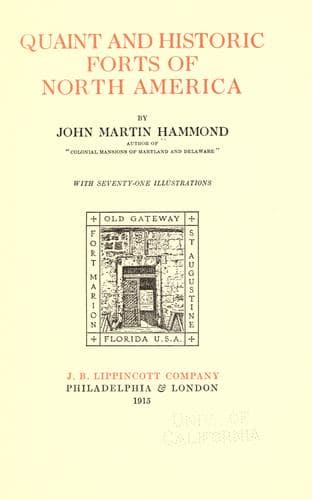
Quaint and Historic Forts of North AmericaHammond, John Martin
History
Quaint and Historic Forts of North America
Hammond, John Martin
Fortification -- North America; Fortification -- United States; Historic buildings -- United States
Count Donop, with 1200 picked Hessians, was sent by Howe to take
Fort Mercer. On the morning of October 24, he appeared before the
little fort. Though the Americans had only 400 men with fourteen
cannon they were not dismayed but stood to their arms. The battle
commenced at four o’clock in the afternoon and raged with great
fierceness. It resulted in the repulse of the assailants and the
death of their commander, Count Donop, to whom a monument has been
erected at Fort Mercer Park.
The firing of the first gun against Fort Mercer was the signal for
the British fleet to open upon Fort Mifflin. A heavy cannonade
continued until the British were obliged to draw off. A hot shot
struck one of their large ships, the _Augusta_, and this vessel
burned to the water’s edge.
[Illustration: THE MOAT IN WINTER, FORT MIFFLIN, PHILADELPHIA]
For a season the Americans held undisputed possession of their
section of the Delaware, but then the British returned the
charge with increased force. Fort Mifflin was made the centre
of attack. Batteries were posted upon Province Island,--now a
part of the mainland directly off Mud Island on which the little
fort stood,--and on this side the fort was not finished. A large
floating battery was also brought up the river within forty yards
of one angle of the fort. Altogether the British had fourteen
strong batteries, in addition to four 64-gun and two 40-gun ships.
The engagement opened on the 10th of November and continued for six
consecutive days without interruption. In the course of the last
day more than a thousand discharges of cannon were made against the
little fort on Mud Island. By this time there was little left of
its walls and no single chance of the garrison holding out longer.
The officer in command escaped to Fort Mercer with the remnants of
his force. It is said that the British were preparing to draw away
from Fort Mifflin and had made up their minds to give up the
siege, but information from a deserter caused them to keep on for
the few days necessary to reduce the weakened stronghold.
So strong a force was now sent against Fort Mercer that Colonel
Greene was obliged to evacuate that post, leaving behind some guns
and ammunition with military stores.
The American fleet sought safety in flight up the Delaware. One
brig and two sloops escaped to Burlington. Seventeen other vessels,
unable to escape, were abandoned by their crews and burned at
Gloucester, just across from the Philadelphia of to-day.
The Delaware River and Philadelphia were now in the hands of Howe.
For a long winter he was to lie inactive while Washington took up
position at Valley Forge and spent that historic winter with his
men of which so much has been written. Instead of working for the
future the British spent their time in balls and the Meschianza.
Let Americans of to-day be thankful that they found Philadelphia
manners and Philadelphia belles so altogether delightful!
FORT McHENRY
BALTIMORE
Public-domain text, read in full here on John Shaqi.
Reviews
Reviews
No reviews yet
Be the first to share your thoughts on this work.
Elsewhere in the archive
Join the Discussion
Join the discussion
Sign in to leave a comment or review.
Sign InorCreate an account