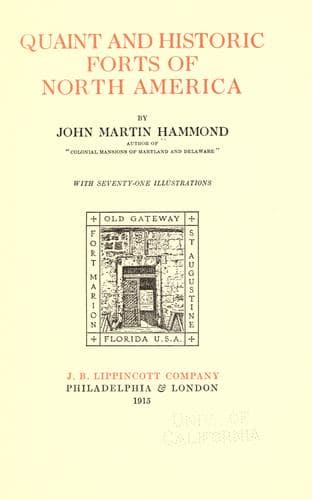
Quaint and Historic Forts of North AmericaHammond, John Martin
History
Quaint and Historic Forts of North America
Hammond, John Martin
Fortification -- North America; Fortification -- United States; Historic buildings -- United States
During the night which followed the unsuccessful afternoon
engagement of the 13th a landing party was sent in boats with
muffled oars to slip past the City Battery and Fort Covington
and to take these works and McHenry in the rear. That this
effort was not more successful is due to the presence of a large
hay-stack near one of the American sentries. This sentry, becoming
suspicious, touched a match to the hay-stack, and the sudden
flames showed the landing party of British. In the engagement that
followed the British were repulsed.
It was at dawn of the 14th that Francis Scott Key, who was a
prisoner on the British flag-ship, received the inspiration to
write “The Star Spangled Banner.” He saw that, despite the furies
of the night, the American flag still waved over the little fort.
The words which he jotted down in the joy of that moment were the
subject of some reworking on his part, but, it is understood,
had not been materially changed when he showed them to his
brother-in-law, Judge Nicholson, after his exchange the next
morning. The words were found to fit perfectly to the popular tune
“Anacreon in Heaven.” Carrying the stanzas to the printing office
of Benjamin Edes, copies of it were ordered printed. This was the
birth of “The Star Spangled Banner.”
The real hero of the attack upon Fort McHenry, is not, perhaps,
given the acclaim that should be his. It was sturdy Colonel
Armistead, commander of the fort. His intrepid spirit and fine
ingenuity undoubtedly saved the day.
Among the tributes which were rendered to Colonel Armistead after
the engagement may be repeated that of his old friend, the veteran
Colonel John Eager Howard, who sent him a brace of ducks and some
wine with the words:
The British are off and the Devil with them. You deserve the
thanks of a grateful country. I am sending a brace of ducks and a
bottle of Burgundy. I hope you may enjoy them.
[Illustration: COL. GEORGE ARMISTEAD
In command of Fort McHenry during the siege]
During the Civil War Baltimore was again fortified. On the night
of May 13, 1861, Major-General Butler occupied Federal Hill,
a commanding eminence over-looking the city and harbor. In
the following month a strong fort was erected here by General
Brewerton, which included the entire crown of the hill and mounted
fifty guns. The building of Federal Hill Fort was an answer to
the action of a mob in Baltimore in April, 1861, which planned to
seize Fort McHenry. This effort was frustrated by the garrison of
100 men under Captain Robinson which put up such a war-like front
with such a display of grape and canister, that the enterprise was
abandoned.
In September, 1914, during the Star Spangled Banner Centennial, the
fort and grounds were loaned to the City of Baltimore by the War
Department for use as a public park. It is not to be expected that
the old fort will ever again be called into active service.
FORT MARION
ST. AUGUSTINE--FLORIDA
Public-domain text, read in full here on John Shaqi.
Reviews
Reviews
No reviews yet
Be the first to share your thoughts on this work.
Elsewhere in the archive
Join the Discussion
Join the discussion
Sign in to leave a comment or review.
Sign InorCreate an account