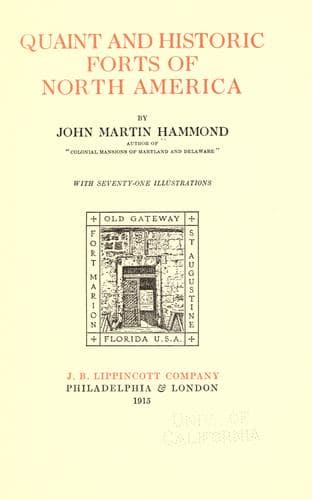
Quaint and Historic Forts of North AmericaHammond, John Martin
History
Quaint and Historic Forts of North America
Hammond, John Martin
Fortification -- North America; Fortification -- United States; Historic buildings -- United States
Passing up the inclined plane to which allusion has already been
made one finds one’s self on the ramparts of the fort. A charming
view is to be obtained on all sides, but particularly looking out
to sea. At each angle of the fort was a sentry-box and that at the
northeast corner was also a watch-tower. This tower, probably the
most familiar remembrance of old Fort Marion, is twenty-five feet
high. The distance from watch-tower to sentry-box (or from corner
to corner) of the old fort is 317 feet.
The material of which the fort is constructed is the familiar
sea-shell concretion used so largely in Florida and known as
“coquina.” It was quarried on Anastatia Island, across Matanzas
Inlet from the city, and was ferried over to the fort site in
large barges. The substance is softer when first dug than when it
has been exposed to the air and light for a season, sharing this
property with concrete, to which it is analogous in other ways, so
the walls of the fort are more solid to-day than when they were
built.
The history of Fort Marion takes one back to early bickering
between Spanish and French on the North American continent. In 1562
Jean Ribaut, a sturdy French mariner, sailed into the waters of
Florida, explored the waters of the St. John’s River (at the mouth
of which busy Jacksonville now stands) and planted a colony and a
fort on the St. John’s with the name of Fort Caroline. The river he
called the River of May, in remembrance of the month in which he
first set eyes upon it. In 1564, Laudonierre, a second Frenchman,
came with supplies and reinforcements for Fort Caroline, but
paused on his passage to investigate an inlet farther south than
the mouth of the St. John’s River. This inlet he called the River
of Dolphins, from the abundance of such creatures at play in the
waters here and on the shores of the inlet, which later generations
were to know as St. Augustine harbor; he descried an Indian village
known as Seloy.
The jealous King of Spain heard of the French settlement in Florida
and was displeased. He sent an expedition under Juan Menendez de
Aviles to colonize the country with Spaniards and to exterminate
the French, who added to the misfortune of not being Spaniards
the mistake of not being Catholics. Menendez sailed into Florida
waters in September, 1565, reconnoitred the French colony on the
St. John’s River and then sailed south several days, landing at the
Indian village of Seloy. Here he decided to establish the capital
of his domain. The large barn-like dwelling of the Indian chief was
made into a fort. This was the original of Fort Marion of to-day.
Then on September 8, 1565, Menendez took final possession of the
territory, and named his fort San Juan de Pinos.
Public-domain text, read in full here on John Shaqi.
Reviews
Reviews
No reviews yet
Be the first to share your thoughts on this work.
Elsewhere in the archive
Join the Discussion
Join the discussion
Sign in to leave a comment or review.
Sign InorCreate an account