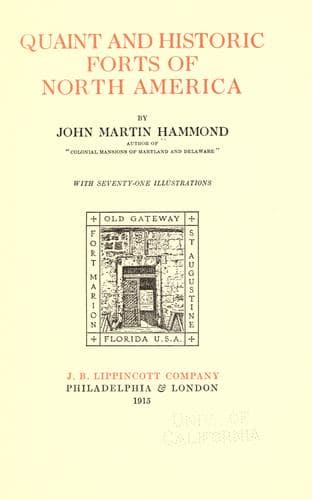
Quaint and Historic Forts of North AmericaHammond, John Martin
History
Quaint and Historic Forts of North America
Hammond, John Martin
Fortification -- North America; Fortification -- United States; Historic buildings -- United States
De Soto came to Havana in the fashion of leisure of the times, and
in pursuit of his royal master’s instructions, laid the foundations
of a fortress. This work was finished under the direction of his
lieutenant while he, himself, was searching an El Dorado in Florida
and was finding a miserable death by fever on the Mississippi.
The structure which de Soto left as his legacy to Havana is the
Castillo de la Fuerza, half hidden, to-day, between the Senate and
old post-office building on the Plaza de Armes. La Fuerza has been
credited with being the oldest inhabitable and inhabited structure
in the Western Hemisphere and the claim is not easily disputed. As
early as 1544 a royal decree had been given forth that all vessels
entering Havana harbor should salute the little fortress with a
ceremony not enjoyed by any other city in the New World save Santo
Domingo.
The form of la Fuerza is that of a quadrilateral, having a bastion
at each of the four corners. The walls are twenty-five feet in
height and are double. There is a moat which has not contained
water for many years, and arrangements for a draw-bridge which
has been replaced by a permanent plank walk. To the seaward is a
watch-tower similar in design to that on the fort at St. Augustine,
and in this tower is a bell which, tradition says, was rung wildly
whenever in the old days a suspicious sail came into the view of
the watchman. The little bronze image in the top of the tower is
known as “La Habana.” When de Soto sailed out from Havana harbor
on that storied expedition through the American wilds which was to
end in his death, he left la Fuerza, and with it his command as
governor, in charge of his bride, Isabel de Bobadilla. For four
years Lady Isabel waited for her lord’s return, spending anxious
hours in the little watch-tower of the fort. Only when the tattered
remnants of that splendid army which had accompanied the adventurer
were brought back to Havana was her long suspense ended.
[Illustration: MORRO CASTLE, HAVANA, CUBA]
The cellars of la Fuerza contain damp dungeons used as
receptacles for modern rifles and ammunition, this part of the old
fort being given over to the purposes of an armory.
In 1554 Havana was again attacked by the French and partially
destroyed and in the following year it fell a victim to pirates.
During the wars which marked the reigns of the Emperor Charles V,
of Spain, and his son, Philip II, the colony became more and more
the object of attack by Spain’s enemies, and in 1585, Havana having
been seriously menaced by Sir Francis Drake, it was determined to
build additional defences for the city. In 1589 Morro Castle, the
Castle of the Three Kings and the Bateria de la Punta were begun;
by 1597 they were completed.
Public-domain text, read in full here on John Shaqi.
Reviews
Reviews
No reviews yet
Be the first to share your thoughts on this work.
Elsewhere in the archive
Join the Discussion
Join the discussion
Sign in to leave a comment or review.
Sign InorCreate an account