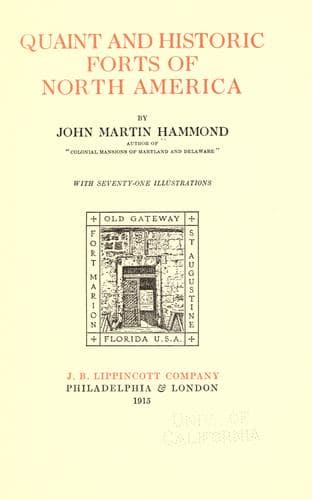
Quaint and Historic Forts of North AmericaHammond, John Martin
History
Quaint and Historic Forts of North America
Hammond, John Martin
Fortification -- North America; Fortification -- United States; Historic buildings -- United States
This has been called the first time in history that two forts waged
battle against each other. It was like two strong men, tied by the
feet, almost beyond reach of each other, being allowed to strike at
each other until one or the other should fall.
To understand something of the conditions which governed this very
historic bout between Fort Sumter and Fort Moultrie, one must have
some idea of the lay of the land at Charleston. Charleston, itself,
it may be pointed out, is situated on a long narrow spit of land
at the juncture of the Ashley and Cooper Rivers. The arrow-head
formed by these two rivers points almost directly toward the mouth
of Charleston Bay, where the waters of the two rivers joined mingle
with the Atlantic Ocean. Let us go to the point of the arrow-head
upon which Charleston is situated, to the Battery,--that is,
Charleston’s most famous public park,--and gaze seaward: Five miles
away, across a shimmering blue, we see a little geometrical dot
almost midway between the jaws which hold Charleston Bay. This
is Fort Sumter, a little stone work built by the United States
Government in 1828 on a sandy shallow. Fort Moultrie is situated
on Sullivan’s Island, on the northern one of the two jaws of the
bay, a body of land really distinct from the mainland but which
seems from this distance to be a part of that land. Of the two
fortifications, Fort Moultrie is the older and by long odds the
more interesting as to past.
Wise heads of both sections in 1860 saw that war was inevitable
between the North and the South, though patriots did their best to
prevent armed conflict. But the doctrine of State individualism
or State’s Rights was too firmly established to be gotten from
the body corporate without a purging of blood, just as individual
rights in the social structure can never be enforced to the last
limit without conflicting with the community purpose. So when, on
Christmas night, 1860, Major Anderson, commanding at Fort Moultrie,
moved his whole force secretly over to the sub-post, Fort Sumter,
and sent his women and children to Charleston, with the request
that they be sent north, the citizens of Charleston, at least, knew
that the issue had been squarely met, to be settled at the court of
last resort.
[Illustration:
Copyright Detroit Publishing Co.
FORT SUMTER, A PILE OF STONE ON A SANDY SHOAL]
Mrs. St. Julien Ravenel, in her delightful reminiscences of
Charleston, writes:
Doubt and delay were gone. Then came the call to arms....
January, February, and March were so full of crowded life that
they seemed an eternity, yet one dreaded lest eternity should
end. End it did when one night at eleven o’clock seven guns
thundered out over the town and every man sprang up, seized
his rifle and ran to the wharves. It was the signal that the
relieving fleet (from the north) was on its way south, and that
the whole reserve must hurry to the islands.
Public-domain text, read in full here on John Shaqi.
Reviews
Reviews
No reviews yet
Be the first to share your thoughts on this work.
Elsewhere in the archive
Join the Discussion
Join the discussion
Sign in to leave a comment or review.
Sign InorCreate an account