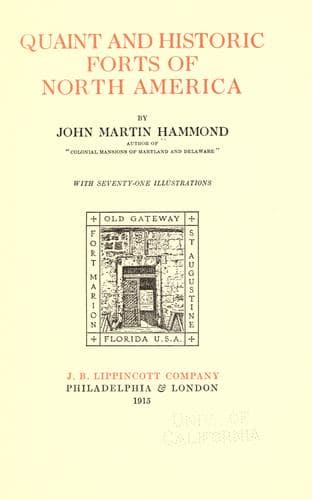
Quaint and Historic Forts of North AmericaHammond, John Martin
History
Quaint and Historic Forts of North America
Hammond, John Martin
Fortification -- North America; Fortification -- United States; Historic buildings -- United States
The rattle-snake flag flying over the American fort was shot down,
and Sergeant Jasper, leaping over the parapet, braved the fire of
the British to recover the emblem. Sergeant Jasper lost his life at
Savannah in an effort to duplicate this same feat.
At length the British drew off beaten. They had lost heavily, on
the flag-ship alone 104 men being killed. The American loss was
12 killed and 25 wounded. When the news of this defeat reached
England, though the intelligence was given out by the Admiralty
in the most politic fashion possible, it was a terrible blow to
English pride. “That an English admiral with a well-appointed fleet
of 270 guns should be beaten off by a miserable little half-built
fort on an uninhabited sand bank was incomprehensible,” wrote a
correspondent from London. Had Moultrie had powder enough the
British loss must have been much heavier than it was.
On the 9th of April, 1780, Fort Moultrie was again in action, when
it opened upon Admiral Arbuthnot’s fleet which was sailing into
the harbor in the course of the operations against Charleston that
year. It was unable to prevent the passage of the fleet but it
inflicted some damage to the vessels and killed 27 of the enemy.
Shortly after Fort Moultrie fell to an overwhelming force of
British who attacked by land, and was not again in action during
the Revolution.
FORT PULASKI
AT MOUTH, SAVANNAH RIVER--GEORGIA
The trip from beautiful Savannah to the battered ruins of the once
famous brick fortress, Pulaski, takes one through that gold and
green country which one comes to associate with the name of this
charming southern city. Fort Pulaski is that great hexagon of
brick which one sees from incoming steamers on Cockspur Island at
the mouth of the muddy Savannah River, and all the country round
about is marshy, reedy land, cut up by big and little streams with
no hills to be seen and only scraggy pine trees breaking the flat
monotony of the horizon.
If one would go to Fort Pulaski from Savannah, he seeks out the
little railroad which runs to Tybee, and whose passenger traffic is
confined almost exclusively to summer. There he will be received
by the hospitable southern trainmen and put off the train near
the light-house which graces the northern end of Cockspur Island.
Here, if he has been wise and has made his arrangements properly,
the will be met by a boat from the light-house and will be carried
across to the island.
Arrived at the landing which gives access to the fort, one is
struck by the graceful desolation of the scene. The boards and
timbers of the wharf have rotted, and ends of planks hang down
toward the water like withered arms. Yet the brilliant Georgia
sunshine gives a charm to it all. One does not feel in the presence
of decay; one feels only in the presence of something that is
passing painlessly away.
Public-domain text, read in full here on John Shaqi.
Reviews
Reviews
No reviews yet
Be the first to share your thoughts on this work.
Elsewhere in the archive
Join the Discussion
Join the discussion
Sign in to leave a comment or review.
Sign InorCreate an account