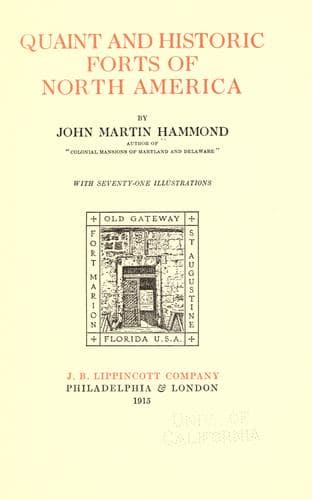
Quaint and Historic Forts of North AmericaHammond, John Martin
History
Quaint and Historic Forts of North America
Hammond, John Martin
Fortification -- North America; Fortification -- United States; Historic buildings -- United States
The first United States troops which arrived here came in July,
1840, under the command of Major Sanderson of the Mounted Rifles.
They were companies C and D of that regiment. Company G of the
Sixth United States Infantry arrived in August of the same year
under command of Captain Ketchum. In the summer and fall of 1840 a
large number of additions were made to the buildings at the post.
In 1846, just prior to its occupancy by the United States,
Francis Parkman, the future historian, then little more than a
boy, visited Fort Laramie and wrote a description of the place in
that singularly vivid style which characterized his best work as a
historian. His description may be abridged:
Looking back, after the expiration of a year, upon Fort Laramie
and its inmates, they seem less like a reality than like some
fanciful picture of the olden time; so different was the scene
from any which this tamer side of the world can present. Tall
Indians, enveloped in their white buffalo robes, were striding
across the area or reclining at full length on the low roofs
of the buildings which enclosed it. Numerous squaws, gayly
bedizened, sat grouped in front of the rooms they occupied;
their mongrel offspring, restless and vociferous, rambled in
every direction through the fort; and the trappers, traders, and
engagees of the establishment were busy at their labor or their
amusements....
Fort Laramie is one of the posts established by the “American Fur
Company” which well nigh monopolizes the Indian trade of this
region. Here its officials rule with an absolute sway; the arm of
the United States has little force; for when we were there the
extreme outposts of her troops were about seven hundred miles to
the eastward. The little fort is built of bricks dried in the
sun, and externally is of an oblong form, with bastions of clay,
in the form of ordinary blockhouses, at two of the corners. The
walls are about fifteen feet high, and surmounted by a slender
palisade. The roofs of the apartments within, which are built
close against the walls, serve the purpose of a banquette.
Within, the fort is divided by a partition: on one side is
the square area, surrounded by the offices, store-rooms and
apartments of the inmates; on the other is the corral, a narrow
place, encompassed by high clay walls, where at night, or in
presence of dangerous Indians, the horses and mules of the fort
are crowded for safe keeping. The main entrance has two gates,
with an arched passage intervening. A little square window, high
above the ground, opens laterally from an adjoining chamber
into this passage; so that when the inner gate is closed end
barred, a person without may still hold communication with those
within, through this narrow aperture. This obviates the necessity
of admitting suspicious Indians, for the purposes of trading,
into the body of the fort; for when danger is apprehended, the
Public-domain text, read in full here on John Shaqi.
Reviews
Reviews
No reviews yet
Be the first to share your thoughts on this work.
Elsewhere in the archive
Join the Discussion
Join the discussion
Sign in to leave a comment or review.
Sign InorCreate an account