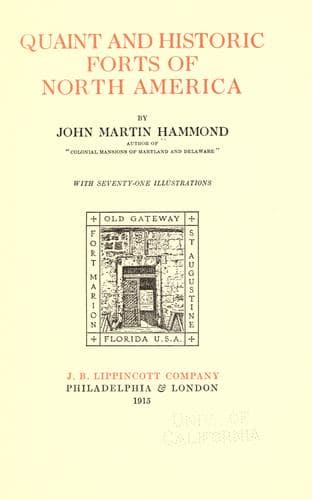
Quaint and Historic Forts of North AmericaHammond, John Martin
History
Quaint and Historic Forts of North America
Hammond, John Martin
Fortification -- North America; Fortification -- United States; Historic buildings -- United States
FORT PHIL KEARNEY, NEBRASKA; FORT LEAVENWORTH, KANSAS; FORT
FETTERMAN, WYOMING; FORT BRIDGER, WYOMING; FORT KEOGH, MONTANA;
FORT DOUGLAS, UTAH
One of the most dreadful Indian fights in the history of the Middle
West is associated with Fort Phil Kearney, on the Platte River,
Nebraska, which was in 1848, at the time of its establishment,
the only United States post between Fort Leavenworth, Kansas, 350
miles distant, and Fort Laramie, 420 miles to the west. It stood
midway between the Mississippi River and the Rocky Mountains on the
California Overland route and was established for the protection of
west-bound emigrant trains from hostile Indians.
Fort Phil Kearney was a storm centre during the Sioux War, which
began in 1863 and continued intermittently for nearly ten years,
and the “Kearney Massacre” occurred during this time. On the
morning of December 21, 1866, the fort received word that the wood
train was being attacked by Indians and was in need of assistance.
Immediately Brevet Lieutenant Colonel W. I. Fetterman with
seventy-six men was ordered to protect the train.
Colonel Fetterman moved rapidly upon his errand, and the sound of
heavy firing soon showed that he was in contact with the enemy. The
firing continued so long that the commandant, Colonel Carrington,
became alarmed for the safety of the detachment and sent out as
many men as he could spare for reinforcement. These men were under
Captain Ten Eyck. The rest of the story may be taken up in the
words of Senate Document 13, 1867:
Colonel Ten Eyck reported as soon as he reached the summit
commanding a view of the battle-field that the valley was full of
Indians; that he could see nothing of Colonel Fetterman’s party,
and requested that a howitzer should be sent him. The howitzer
was not sent.
The Indians who at first beckoned him to come down now commenced
retreating and Captain Ten Eyck, advancing to a point where the
Indians had been standing in a circle, found the dead, naked
bodies of Brevet Lieutenant Colonel Fetterman, Captain Brown and
about sixty-five of the soldiers of their command.... At about
half the distance from where these bodies lay to the point where
the road commences to descend to Peno Creek was the dead body of
Lieutenant Grummond, and still farther on, at the point where the
road commences to descend to Peno Creek, were the dead bodies
of three citizens and four or five of the old, long-tried and
experienced soldiers.
Public-domain text, read in full here on John Shaqi.
Reviews
Reviews
No reviews yet
Be the first to share your thoughts on this work.
Elsewhere in the archive
Join the Discussion
Join the discussion
Sign in to leave a comment or review.
Sign InorCreate an account