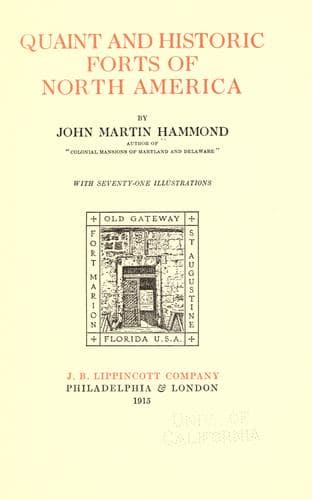
Quaint and Historic Forts of North AmericaHammond, John Martin
History
Quaint and Historic Forts of North America
Hammond, John Martin
Fortification -- North America; Fortification -- United States; Historic buildings -- United States
As early as 1806 a trading station was established in the valley
of the Columbia River by The Northwest Fur Company, an English
corporation. In 1810 the Pacific Fur Company, which was to found
the fortunes of John Jacob Astor, was organized by that gentleman
in New York and, in 1811, the first of Astor’s ships arrived at the
mouth of the Columbia River to erect the trading post of Astoria,
whose fortunes have been so entertainingly told by Washington
Irving in the book of that name. The Hudson Bay Company had also
made entrance to this rich field.
During the War of 1812 the Pacific Fur Company retired from its
positions in the Columbia valley and the Hudson Bay Company
absorbed its English rival, the Northwest Fur Company. The English
built a strong fort at Astoria which they called Fort George. But
several years after the conclusion of the war between England and
America, the Pacific Fur Company resumed possession of its posts
in the Columbia, with the backing of the United States government,
under the authority of the Treaty of Ghent and the Hudson Bay
Company, and though events proved that it could maintain an
amicable joint household with Astor’s corporation at Astoria, began
to look about for a site for headquarters of its own. Since the
Columbia River at that time seemed destined to become the dividing
line between English and American possessions, a site was chosen
on the north side of the river, about 120 miles above its mouth.
Here a strong post was established in 1825 and named Vancouver, in
honor of the British mariner. The site was not deemed as suitable
for the purposes of a fort as a situation a short distance away, so
a second Fort Vancouver was built on the last chosen spot. This is
the Fort Vancouver of the present day, and the site of the city of
Vancouver, Washington.
The new post was made the Pacific head-quarters for the Hudson
Bay Company and became a great mart of trade from California to
Alaska and for innumerable little stations in the Rocky mountains
and the hinterland thereof. The fort, itself, was an imposing
structure with a picket wall twenty feet high, buttressed with
massive timbers inside. It enclosed a parallelogram five hundred
feet by seven hundred feet and contained forty buildings, including
a governor’s residence of generous proportions. The lands outside
of the fort proper were cultivated and were exceedingly productive.
The employees of the company were comfortably housed and formed a
happy community, and to the point came red men in various garbs,
hunters, trappers and woodsmen, a picturesque throng in craft of
all description.
Public-domain text, read in full here on John Shaqi.
Reviews
Reviews
No reviews yet
Be the first to share your thoughts on this work.
Elsewhere in the archive
Join the Discussion
Join the discussion
Sign in to leave a comment or review.
Sign InorCreate an account