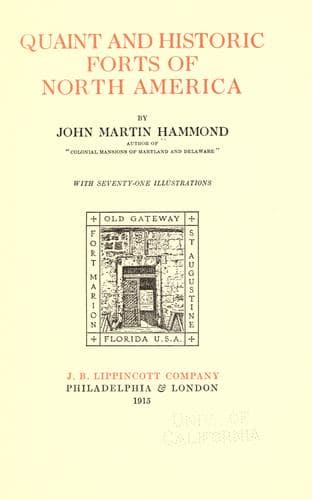
Quaint and Historic Forts of North AmericaHammond, John Martin
History
Quaint and Historic Forts of North America
Hammond, John Martin
Fortification -- North America; Fortification -- United States; Historic buildings -- United States
The grounds of the Gettysburg National Park, Adams County,
Pennsylvania, comprise 2,054 acres and their acquisition was
commenced in 1873. The scenes of the principal movements of the
battle have been marked with suitable monuments. The battle of
Gettysburg proved conclusively that the South could not invade the
North. It was the last gallant attempt of a completely invested
country to strike a fatal blow before the strangle-hold of its
enemy should bring the end.
[Illustration: The Slaughter Hollow
The Entrance to the Tunnel
TWO VIEWS TO-DAY OF THE “CRATER,” PETERSBURG, VA.]
The largest of the national military parks is Chickamauga and
Chattanooga National Park, which comprises 5,688 acres in the
State of Georgia, in addition to nearly 150 acres in the State
of Tennessee, the park being situated on the line between the
States. In Tennessee is located Lookout Mountain. The acquisition
of this reservation began under the provisions of an Act of
Congress approved August 19, 1890.
On the outskirts of Petersburg, Virginia, the remains of Forts
Haskell and Steadman, the scene of the “Crater” episode, and part
of the defences of the capital of the Confederacy which fell
before Grant in 1865, have been preserved as a private enterprise.
For a small consideration the “Crater” and the earthworks will
be shown to the visitor. The Federal forces opposed to Fort
Steadman--at the suggestion of a miner from Chambersburg, Pa., it
is said--constructed a long tunnel from their lines to beneath the
Confederate stronghold. An enormous quantity of powder was here,
and when it was set off a body of soldiers was to charge through
the breach and take the Confederate positions.
The powder was exploded and the plan was successful in so far that
it blew several hundred men into eternity, but when the attacking
column reached the cavity in the ground its men became confused,
giving the Confederates time to reform and to pour in a terrible
fire upon the Union men concentrated in the broken ground below.
The result was terrible carnage of United States troops. The
“Crater” had become a death trap. Nearly three thousand men were
killed in it in thirty minutes, the most disastrous loss the
Federal forces suffered in so short a time during the war.
The “Crater” to-day is a peaceful spot glorified by tall trees
which keep the scene in continual gloom. The depression in the
ground is ten feet or more in depth and about two hundred feet in
diameter. A short walk brings one to the entrance to the tunnel
where the lines of the United States were stretched.
INDEX
Adams, Fort, Newport, R. I., 222-231
Alamo, Texas, 279-284
Allen, Ethan, 63, 70
Amsterdam, Fort, 37
André, Major, 156
Andros, Edmund, Royal Governor of Mass., 29, 107
Annapolis Royal, 2, 84-92
Arnold, Benedict, 64, 82;
his treason, 154 et seq., 169, 171, 238
Atares Castle, Havana, 206
Baltimore, Fort at, 180-189
Battery, The, New York City, 46
Belfast, Me., 90
Public-domain text, read in full here on John Shaqi.
Reviews
Reviews
No reviews yet
Be the first to share your thoughts on this work.
Elsewhere in the archive
Join the Discussion
Join the discussion
Sign in to leave a comment or review.
Sign InorCreate an account