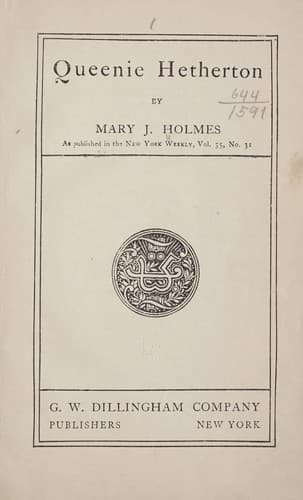
American fiction -- 19th century; Dime novels; Man-woman relationships -- Fiction; Upper class -- Fiction
“And that is just the reason you will come to-morrow,” Queenie said,
coaxingly. “It is my first family party, and you will not be so uncivil
as to refuse. I shall expect you without fail,” and with a smile and
flash of her eyes, which stirred even staid Tom Ferguson a little,
Reinette drove away, saying to Phil, who was going to ride home with her
and then walk back to the Knoll: “I hope he _will_ come, for I could see
that Anna did not wish him to. Such airs as she has taken on since she
split up that sign and quit the business, as she terms it! Does she
suppose it is what one does which makes a lady? Oh, Phil, why is there
such a difference between people of the same blood? There’s your mother,
as cultivated and refined as if she had been born a princess, and
there’s Anna and grandma, and Uncle Tom. Is it American democracy? If
so, I am afraid I don’t like it;” and, leaning back in the carriage,
Queenie looked very sober, while Phil said good-humoredly:
“In rebellion against the Fergusons again, I see. It will never do to go
against your family; blood is blood, and there’s no getting rid of it or
of _us_.”
“I have no wish to be rid of you, but I may as well confess it, I do
wish mother had been somebody besides a Ferguson,” Reinette replied;
then added, laughingly: “Don’t think me a monster—I can’t help the
feeling; it was born in me, and father fostered it; but I am trying to
overcome it, you see, for haven’t I invited them all to dinner? You must
come early, Phil—very early, so as to help me through.”
Phil promised, and as they had reached Hetherton Place by this time, and
it was beginning to grow dark, he bade her good-night, and walked
rapidly back to the Knoll.
CHAPTER XXI.
THE DINNER.
True to her promise, Reinette drove round to see Margery the next
morning, and carried a pile of dresses which scarcely needed a stitch,
but which she insisted should be changed, as she knew Margery needed
work. She found her friend well and delighted with the cottage, which
suited her in every particular. Mrs. La Rue, too, was very calm and
quiet, and only spoke to Reinette when spoken to, until the latter, in
speaking of Hetherton Place and how lonely she was there at times,
especially in the evening, when Phil was not with her, said:
“I am going to hunt up my old nurse, who was with mother when she died.
She is alive, I am sure, and somewhere in England or France. I shall
have her come to live with me.”
Mrs. La Rue was standing with her back to Reinette, picking the dead
leaves from a pot of carnations, but she turned suddenly, and facing the
girl, said quickly:
“Better leave the nurse where she is; you will be happier without her.”
“I don’t know why you should say that,” Reinette retorted, in a tone
which showed her irritation that Mrs. La Rue should presume to dictate;
“you certainly can know nothing of Christine Bodine.”
Public-domain text, read in full here on John Shaqi.
Reviews
Reviews
No reviews yet
Be the first to share your thoughts on this work.
Elsewhere in the archive
Join the Discussion
Join the discussion
Sign in to leave a comment or review.
Sign InorCreate an account