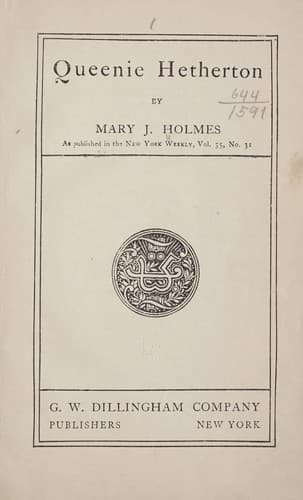
American fiction -- 19th century; Dime novels; Man-woman relationships -- Fiction; Upper class -- Fiction
Margery was a success in Merrivale as a dressmaker, at least. Mrs. Lydia
had done very well, it is true. Her work was always neatly finished and
her prices satisfactory, but she never went farther from home than
Springfield or Worcester, so that there was a sameness and stiffness in
her styles wholly unlike the beautiful garments which came from
Margery’s skillful hands, no two of which were alike, and each one of
which seemed prettier and newer than its predecessor, so that in less
than two weeks her rooms were full of work, and her three girls busy
from morning till night, and she had even proposed to Miss Anna to help
her a few hours each day during the busy season. But Anna spurned the
proposition with contempt, saying her days of working for people and
being snubbed by them on account of it were over.
When Queenie heard of this she laughed merrily, and went herself into
Margery’s workshop and trimmed Hattie Granger’s wedding-dress with her
own hands and promised to make every stitch of Anna’s should she succeed
in capturing the major, as she seemed likely to do; but Anna answered
that her wedding-dress, if she ever had one, would not be made in the
country, and so that point was settled.
From the first Margery’s great beauty attracted unusual attention but
upon no one did it produce so great an effect as upon Grandma Ferguson,
who first saw the girl the Sunday after her arrival in Merrivale.
Reinette had told the sexton to give Miss and Mrs. La Rue a seat with
her in the Hetherton pew, describing the two ladies to him so there
could be no mistaking them. But Margery came alone, and whether it was
that the old sexton’s mind was intent upon a short woman in black, or
whether something about Margery herself carried him back to the Sundays
of long ago, when a girlish figure used to glide up the aisle to John
Ferguson’s pew, he made a mistake and Grandma Ferguson had just settled
herself on her cushion and adjusted her wide skirts about her, when a
rustling sound caught her ear, and turning her head she saw a face which
made her start suddenly with a great throb of something like fear as a
tall young girl, simply but elegantly attired in black silk and white
chip bonnet, with a wreath of lilacs around it, took a seat beside her.
Mrs. Rossiter had seen something in the French girl’s face which puzzled
and bewildered her. And grandma saw it, too, and defined it at once, and
drew a long breath as she gazed at the face so like the face of her
Margaret dead over the sea. Who was she, grandma asked herself and
forgot to say her prayers or listen to the sermon, as she wondered and
watched. Others had seen only a likeness to Margaret Ferguson, but the
mother who could never forget saw more than that; she saw her dead child
repeated in this beautiful young girl, who grew restless and nervous
under the scrutiny of the eyes she knew were fastened so constantly upon
her, and was glad when the sermon was over and she could thus escape
them.
Public-domain text, read in full here on John Shaqi.
Reviews
Reviews
No reviews yet
Be the first to share your thoughts on this work.
Elsewhere in the archive
Join the Discussion
Join the discussion
Sign in to leave a comment or review.
Sign InorCreate an account