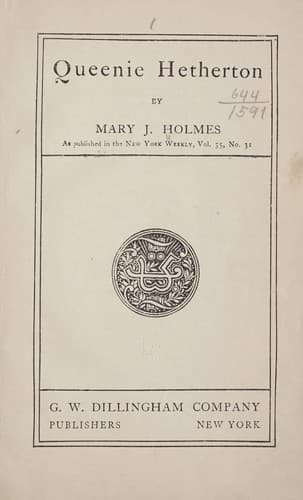
American fiction -- 19th century; Dime novels; Man-woman relationships -- Fiction; Upper class -- Fiction
“Mr. Beresford,” and Reinette’s eyes blazed with scorn, “I did not dream
you were so mean—so dastardly. Idler as you say he is, Phil Rossiter
would cut his tongue out sooner than it should say a word against you,
his friend, were you a thousand times his rival; and you, in your
foolish jealousy, accuse him of wearing women’s dresses, and spinning,
and—”
“Queenie, I did nothing of the sort,” Mr. Beresford said, interrupting
her, and she continued:
“Yes, you did. You likened him to Sardanapalus, which is the same thing,
and I hate you for it!”
“Not more than I hate myself,” Mr. Beresford said, for he was beginning
to be very much ashamed of the weakness which prompted him to speak
against Phil Rossiter, whom he liked so much. “Forgive me, Queenie; it
was unmanly—cowardly in me to attack my rival, and nothing but cruel
disappointment and bitter pain could have induced me to do it. Phil is
my friend, and the most unselfish, kind-hearted fellow in the whole
world. Can you forgive me for saying aught against him?”
Queenie knew he was in earnest, and, as ready to forgive as to take
offense, she answered at once:
“Yes, I know you did not mean it; you could not. Phil may be an _idler_,
I rather think he is, but he is so noble, so good, so unselfish, and
bears with me as no one else ever could. But, Mr. Beresford, you are
mistaken. Phil is not your rival, and it was no thought of him which led
me to refuse you. He is my cousin, and if I loved him ever so much, I
could no more marry him than I could my brother, if I had one. I am
enough of a Roman Catholic to think such a marriage unnatural and
wicked. I could not do it, and I have no desire to—no love for him that
way. Why, I would sooner marry you than Phil; upon my word, I would.”
She had forgiven him, and he knew it, and hope rose suddenly within him,
and taking her hands in his, and holding them tightly there, he began
again:
“Oh, Queenie, you give me new life, new hope, for if Phil is not my
rival, you may come in time to think of me, not now, not for a year,
perhaps, or more, but some time, when you have learned how much I love
you. Promise me that you will try. Put me on trial for a year, during
which time I will not bother you with love-making. I’ll be your staid
old guardian, nothing more. Will you—will you think of it a year!”
“Of what use would that be,” she said, “when at the end of the year I
should think just the same?”
“But you might not,” he replied. “At least give me that chance; give me
one ray of sunlight, for without it the world will be very dreary. I
shall put myself on probation whether you will or not.”
She did not answer him, but stood looking off across the moon-lit
meadows with a troubled look in her dark eyes which he could not fathom.
At last releasing her hands from his, she said, with a little shiver:
“It is growing cold. I must go in now, and you must go home, and never
speak to me again as you have to-night.”
Public-domain text, read in full here on John Shaqi.
Reviews
Reviews
No reviews yet
Be the first to share your thoughts on this work.
Elsewhere in the archive
Join the Discussion
Join the discussion
Sign in to leave a comment or review.
Sign InorCreate an account