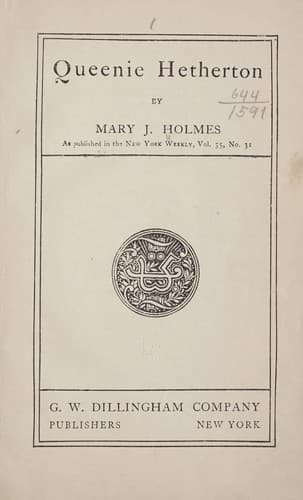
American fiction -- 19th century; Dime novels; Man-woman relationships -- Fiction; Upper class -- Fiction
“Who have nothing to do but amuse themselves and others. It is all very
nice in cousins and brothers to know how to run our sewing-machines and
how our dresses should be trimmed and ought to hang, but we wish our
husbands to be different from that; wish them to have some aim in
life—some occupation, and you have none. You have never done anything
toward earning your own living. Your father is rich, it is true, and
able to support you, but it is more manly to support one’s self—don’t
you think so?”
She spoke very gently, but every word was a sting, and hurt Phil, if
possible, more than her rejection of him had done.
“Yes, I see,” he answered bitterly. “You think me a lazy dog, whom
people generally despise, and so I am, but it is very hard to hear it
from you, Queenie; hard to know that I have neither your love nor your
respect, when, fool that I was, I believed I had both.”
“And so you have, Phil; so you have,” Reinette said, eagerly, touched by
the grieved, hopeless expression of his face, which was not at all like
Phil’s face, usually so bright and happy. “You have both my love and
respect—love as a sister—for neither Ethel nor Grace can love you better
than I do, in a certain way, and I respect and esteem you as the
kindest, and best, and most unselfish Phil in all the world. Don’t,
Phil, oh, don’t cry!” she continued, in a tone of agonized entreaty, as
the great tears, which he could not restrain, rolled down his white
face, which was convulsed with pain. “If you cry like that, I shall wish
I were dead, and I almost wish so now,” she added, frightened by the
storm of sobs and tears to which he at last gave vent.
She was still kneeling by him, and she crept down closer to him, and
took his hands from his face, where he had put them, and wiped his tears
away, while her own fell fast as she tried to comfort him and could not,
for in only one way could she do that, and, with her view of the matter
that was impossible. On that point she was as firm and conscientious as
the most rigid Roman Catholic. To marry her cousin would be wicked, and
so there was no hope for him in that way; but may be she could comfort
him in another, and she said, at last:
“Phil, I can never marry you; that is just as impossible as for your
sister to do it, but I can promise never to marry any one else. That
would not be hard, for I do not believe I shall ever see any one for
whom I care as I do for you; and, if you wish it, I’ll swear to remain
single for your sake forever. Shall I?”
“No, Queenie; no. I am not so selfish as that,” he said. “You ought to
marry; you need a husband here at Hetherton Place—somebody with energy
and will, and not an effeminate idler like me.”
He was still smarting from the hurt of her last objection to him, and he
went on:
“Whether you marry or not cannot affect me, for I am going away—going to
do something and be a man, whom you will never taunt again with his
laziness and sloth.”
Public-domain text, read in full here on John Shaqi.
Reviews
Reviews
No reviews yet
Be the first to share your thoughts on this work.
Elsewhere in the archive
Join the Discussion
Join the discussion
Sign in to leave a comment or review.
Sign InorCreate an account