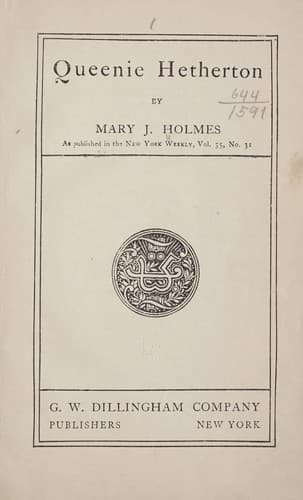
American fiction -- 19th century; Dime novels; Man-woman relationships -- Fiction; Upper class -- Fiction
“I do not know that he did anything. I think it is a fashion in France
more than here for the women to work and the men to take their ease. At
all events, father had no regular occupation that I know of. Sometimes
he acted as guide to strangers, for he could speak a little English, and
sometimes he was employed for a few days as waiter at some of the Duval
restaurants, and once he took mother and me there to dine. That is the
white day of my life, as connected with him. Reinette heard of me from
old Lisette, the laundress, who lived on the floor below, and she came
up to our humble room in her scarlet cloak and hood trimmed with ermine,
and filled it with glory at once. You know what a halo of brightness
seems to encircle her, and affect everything around her. And how she did
sparkle and glow, and light up the whole room, as she sat there in that
hard wooden chair with me standing awkwardly by, in my coarse
high-necked working apron, with broom in hand, and gazing at her as if
she had been a being from another sphere.”
How rapid and excitedly she talked, gesticulating with her hands, which
were as small and white as those of any lady, and how large and bright
her blue eyes grew, as she described that first interview with Reinette
so vividly that Mr. Beresford could see the low room, far up the winding
stairs, the humble furniture, the bare floor, the smoldering fire on the
hearth, the wooden chair, the dark-eyed little girl in scarlet and
ermine who sat there with the captured cat in her lap, talking to
another child quite as beautiful as herself, though of another type of
beauty, and clad in the coarse garments of the poor. He could see it all
so plainly, and forgetting for a time why he was there, he listened
still more intently, while Margery went on to tell him of the Champs
d’Elysees, where she wore the scarlet cloak and played she was Mr.
Hetherton’s little girl, while Queenie sat demurely at her side, clad in
homely garments, and making believe that she was Margery La Rue, whose
home was up the winding stairs in the Rue St. Honore.
“I think that one act bound me to her forever,” Margery said, “though it
was the beginning of many make-believes and many deeds of kindness, for
through Queenie’s influence her father paid my expenses in part at the
English school which she attended, and where I learned to speak your
language and all I know besides, and after that she stood my fast friend
in everything and treated me more like a sister than an inferior, as I
am, by birth and social position. I think her love has never failed me
since the day she first came to me and brought the glorious sunlight
with her. So, do you wonder that I love her? I would lay down my life
for her, if need be—would sacrifice everything for her, and I sometimes
wish that I might have the chance to show how much I love her, and would
endure for her sake.”
Public-domain text, read in full here on John Shaqi.
Reviews
Reviews
No reviews yet
Be the first to share your thoughts on this work.
Elsewhere in the archive
Join the Discussion
Join the discussion
Sign in to leave a comment or review.
Sign InorCreate an account