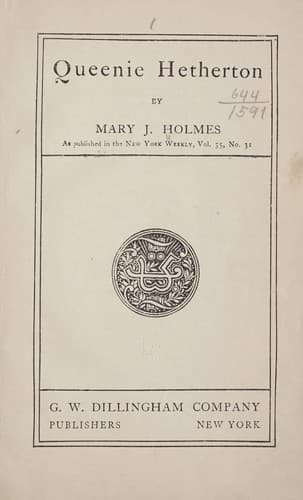
American fiction -- 19th century; Dime novels; Man-woman relationships -- Fiction; Upper class -- Fiction
“Yes, yes, thank you,” Reinette, said, eagerly. “It was something of
that nature, no doubt, and you lawyers are shrewd enough to see it,
while I might have groped in the dark forever. I am glad you thought of
that, and Mr. Beresford, you must tell no one what you heard from Louis
Arnaud. There are many suspicious people in the world who would say hard
things of Christine and—possibly—connect the trouble in some way
with—with—father—and I will not have his name coupled with hers in any
way. My father was a gentleman and a Hetherton.”
Mr. Beresford bowed an acquiescence to the fact that her father was a
gentleman and a Hetherton. And if there was any merit in being the
latter, she certainly was a very fair representative of it as she stood
up so proud and calm, and uttered her protest against her father’s name
being mixed with that of Christine Bodine.
“I am going there now,” she said, adjusting her shawl and drawing on her
gloves, “and when I see you again I shall know everything there is to
know of Christine Bodine.”
Mr. Beresford felt a little doubtful on that subject, but said nothing,
and going with her to her carriage helped her in, and then in a very
thoughtful mood returned to his office, wondering what would be the
result of that call on Christine Bodine.
CHAPTER XXXII.
CHRISTINE.
It was more than a toothache and swollen face which had ailed Mrs. La
Rue, and sent her to her room on that night when Mr. Beresford called
upon Margery. She had a toothache, it is true, and was suffering from
the effects of a severe cold, under cover of which she hid the terrible
pain which was making her sick with nervous apprehension lest, at last,
she was to be confronted by the girl whom she feared and shrank from
more than from all the world beside, unless it was Margery, her dearly
loved, beautiful child, who had brought her the letter which affected
her so strangely. It had been forwarded from Oak Bluffs, and postmarked
originally at Mentone, and it read as follows:
“MADAME LA RUE.—Inclosed find a note from Miss Hetherton, who has
written asking your whereabouts and that this might be forwarded to
you. In my absence, my clerk, Louis Arnaud, took charge of my business
letters, and, it seems, answered the young lady, telling her your
address. Had I been home this would not have occurred, but it cannot
now be helped. Hoping no great harm will come of it, I am
“Your ob’t servant,
“M. ALBRECH.”
Public-domain text, read in full here on John Shaqi.
Reviews
Reviews
No reviews yet
Be the first to share your thoughts on this work.
Elsewhere in the archive
Join the Discussion
Join the discussion
Sign in to leave a comment or review.
Sign InorCreate an account