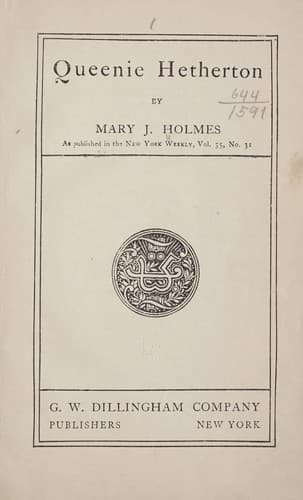
American fiction -- 19th century; Dime novels; Man-woman relationships -- Fiction; Upper class -- Fiction
“REINETTE.”
Oh, how the wretched woman writhed as she read this letter, with thuds
of pain beating in her heart, and her eyes dim with burning tears. It
was so kind, so affectionate in its tone, and so familiar too; so unlike
what Reinette’s manner toward her had been.
“Queenie, my darling, would you write to me thus if you knew?” she
moaned, as she rocked to and fro in her anguish, while at her work below
Margery sat singing a little song she had learned in the Tabernacle at
Oak Bluffs:
“There is rest for the weary,
There is rest for you.”
“Rest for the weary,” Mrs. La Rue repeated, as the clear, sweet tones
floated up to her. “And I am weary, oh! so weary; but there is no rest
for me, except in death, which some say is a long dreamless rest, and
that I can have so soon, for my friend is always near me,” and she
glanced toward the shelf where stood a vial of laudanum to which she had
resort when morphine did not avail to quiet her and bring forgetfulness.
“But I must see Margery once more,” she thought. “I must kiss her again,
and hear her call me mother.”
It was nearly time now for the evening meal, and summoning all her
strength and calmness, Mrs. La Rue went down stairs, and under cover of
the fast-increasing darkness, managed so well that Margery suspected
nothing, and attributed her mother’s pallor and weakness to the
neuralgia from which she was suffering.
“I am going to bed early to-night,” Mrs. La Rue said, when supper was
over, and the table cleared away. “I am feeling quite ill.”
Then Margery looked at her closely, and asked if it was anything more
than neuralgia which ailed her. Was there bad news in the letter?
“No—yes; but nothing I can now explain,” Mrs. La Rue replied; then going
up to her daughter, she kissed her twice, and said: “Good-night, my
darling. Do not speak to me when you come up to bed; I may be asleep.”
Margery kissed her back, with no thought of what was in the mind of the
miserable woman as she slowly climbed the stairs, and, going to her
room, shut the door, and taking down her _friend_, poured out what was
to give her forgetfulness and rest. Drop by drop the dark liquid fell
into the glass, until there were forty drops in all, and she held it to
the light, and looked at it, and smiled as she thought of the morrow,
when she would be deaf to Margery’s call, and deaf to Queenie’s
reproaches, if she should come, as she might do now at any time.
Public-domain text, read in full here on John Shaqi.
Reviews
Reviews
No reviews yet
Be the first to share your thoughts on this work.
Elsewhere in the archive
Join the Discussion
Join the discussion
Sign in to leave a comment or review.
Sign InorCreate an account